The Autonomous Tester: You’ve already written the tests—now run them all

OpenText Core Software Delivery Platform Functional Testing is a cloud-based functional testing solution built within the OpenText Core Software Delivery Platform. It gives QA teams the tools to design, schedule, and execute functional tests through AI-powered codeless scripting, model-based testing, and a digital lab for testing across devices, browsers, and environments.
Over time, most organizations build up a large library of manual tests. These tests capture hard‑earned institutional knowledge about how the application should behave and what matters most to users. Even those written years ago often remain highly relevant, and teams continue to run them regularly.
The problem has never been the quality of the tests. It’s having enough time and people to run them.
Your QA team knows the drill
Write hundreds of manual tests. Document exactly what your app should do, where it’s broken before, and what matters to your users. There’s always another release coming, never enough time to run everything, and someone on the team making a judgment call about what gets skipped. Most of the time it’s fine. Sometimes it isn’t, and a bug makes it out the door.
It’s a capacity problem, not a process problem. Adding more scripted automation won’t fix it because writing and maintaining those scripts takes the exact same amount of time and the same people that are already stretched thin.
This is exactly what the Autonomous Tester was built for.
Introducing the Autonomous Tester in functional testing
Autonomous testing is exactly what it sounds like: software tests that run themselves, without a human at the keyboard.
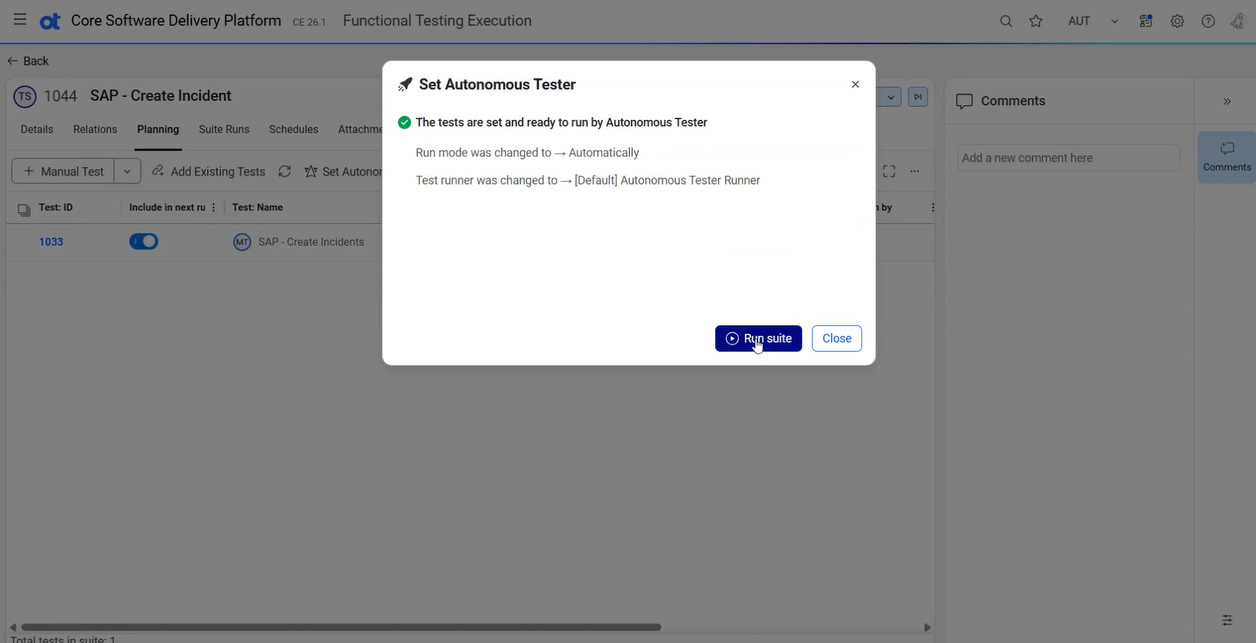
You’ve already done the hard work. The Autonomous Tester takes those existing manual tests and runs them in the cloud, powered by OpenText Aviator. It reads the natural language steps your team already wrote and executes them against your application just like a human tester would.
No converting tests to scripts. No rebuilding your test library. No new format to learn. The tests you’ve always had, but running more often and covering more ground.
Free your team for the testing that actually needs them
The practical upside is immediate. Tests that only get run before major releases can now run regularly. Edge cases that keep getting bumped down the priority list can finally get covered. And your testers can spend their time on the exploratory, judgment-heavy work that needs a human brain, rather than clicking through steps that a machine can handle.
That’s where the real shift happens.
Results you can work with
When a run finishes, you get a full screen recording of everything the agent did — not just a pass/fail count. Combined with step-by-step results, plain-language summaries, and screenshots, you can see exactly what happened instead of reconstructing it from logs. For audit and compliance teams, that documentation generates itself.
Tests that get smarter over time
Most manual tests were written for someone who already knows the product. That’s fine when a human is running them, but it can create gaps when an agent hits a step that needs more context.
Knowledge sources solve this. They give the Autonomous Tester access to reusable information like environment details, login instructions, or product-specific guidance. Up to seven knowledge sources can be used per run, helping the agent resolve vague or incomplete steps without failing out.
On the topic of trusting AI with your tests
Reasonable skepticism here is completely fair. Just a few things worth noting about what this all really means:
- Your tests don’t change. The Autonomous Tester executes what you wrote. It doesn’t modify your test suite or alter test data. Your team reviews and owns the results.
- Everything it does is visible. The run report shows the agent’s reasoning at every step, alongside screenshots and a full recording. Nothing is happening behind a curtain.
Your test library deserves to be used
There’s a lot of institutional knowledge sitting inside manual test suites. Knowledge about how the application is supposed to behave, where it’s broken before, what matters to users. Most of that runs far less often than it should, simply because there aren’t enough hours.
The Autonomous Tester doesn’t ask you to start over. It helps you to get more out of what you’ve already built.
More runs. Better coverage. Richer results.
——————————————————————————————————————————
*The Autonomous Tester requires an Aviator License. OpenText Core Software Delivery Platform Functional Testing is part of the OpenText Core Software Delivery Platform.
For a full breakdown of the latest product release, read what’s new.
Learn more: