Elevating trusted AI and sovereign digital government


Government leaders across Canada are facing a defining moment in digital transformation.
Artificial intelligence is rapidly moving from experimentation into operational reality. At the same time, agencies are under increasing pressure to modernize services, strengthen cybersecurity, protect sensitive information, and maintain public trust—all while navigating growing complexity across data, systems, and regulations.
These themes took center stage at the OpenText™ Government Summit Ottawa, where public sector leaders, technology executives, and cybersecurity experts gathered at the National Arts Centre to explore the future of trusted AI, secure information management, and sovereign digital government.
The summit, called “Elevate Together,” highlighted a clear shift underway across government: the conversation is no longer about whether AI will transform public sector operations. The focus now is on how governments can operationalize AI responsibly, securely, and at scale.
Trusted AI requires trusted context
A recurring theme throughout the summit was that AI effectiveness depends on the quality, governance, and completeness of the information it can access.
OpenText CEO Ayman Antoun pointed out that so far, 85% of AI projects have failed. “This is mostly because of the underlying data,” Antoun said. “Chief data officers don’t trust their own data. If you don’t have a good view of your data management framework, don’t invest in AI. You won’t like the outcome.”
Agencies have invested heavily in:
- Data fabrics and analytics platforms
- Mission and operational systems
- AI copilots and automation tools
But many organizations still struggle with fragmented information environments, where critical context is spread across siloed systems, unstructured documents, and disconnected workflows.
AI systems cannot deliver trusted outcomes if they operate on incomplete or poorly governed information. Instead, governments must focus on activating enterprise knowledge across structured and unstructured environments to provide AI systems with trusted operational context.
This idea aligns closely with broader Canadian government priorities around responsible AI, data governance, and public trust.
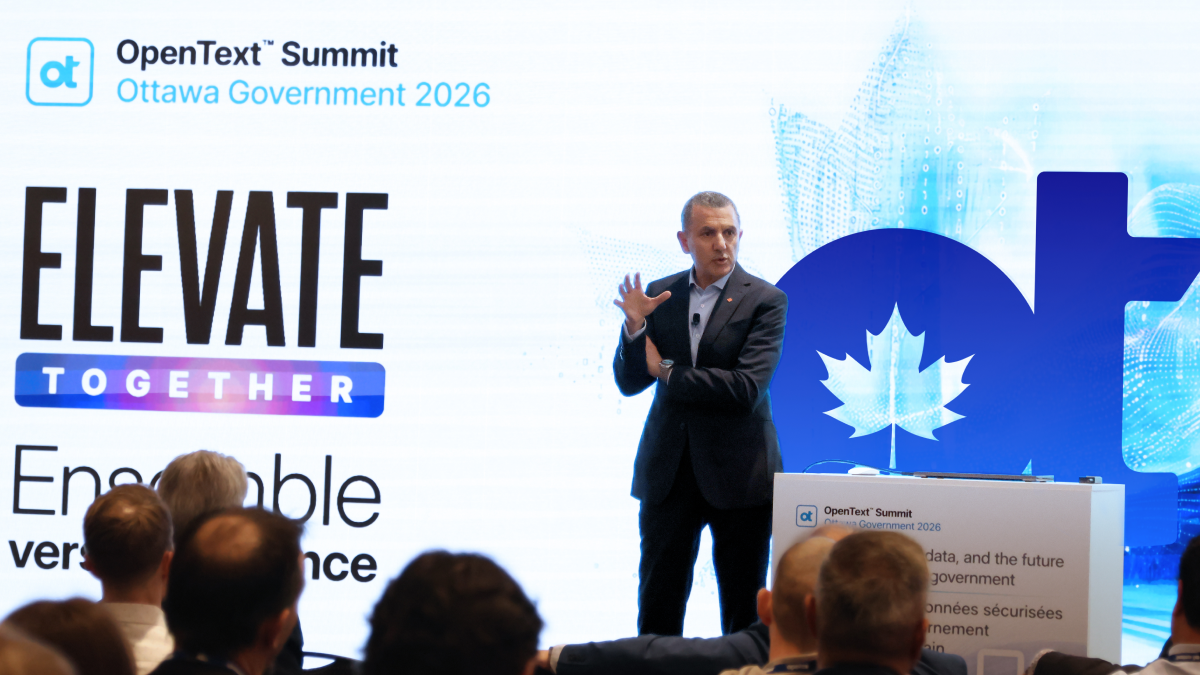
Antoun suggests government ask the following questions before deploying AI:
- Does it serve citizens better?
- Does it make the products we use more effective?
- Does it make government employees work more effectively?
“Fight the urge to invest in AI for the sake of AI,” Antoun said.
Sessions throughout the day reinforced that trusted AI is not simply about models or algorithms—it is about ensuring that the underlying information ecosystem is secure, governed, explainable, and mission-aware.
As a key example, OpenText SVP Shannon Bell showcased the National Operations Center, where 300,000 clients’ information is stored. There AI agents are being deployed to aid human cyber security experts to more efficiently detect alerts, separating high-risk threats from the false alarms.
Sovereign digital government is becoming a strategic imperative
Another major focus of the summit was sovereign digital government.
As governments accelerate cloud adoption and AI deployment, leaders are increasingly prioritizing:
- Data sovereignty
- Secure cloud architectures
- Governance by design
- Vendor flexibility and openness
The summit explored how sovereign digital capabilities can support responsible AI adoption while protecting sensitive government information and strengthening operational resilience.
Mark Schaan, the Canadian Associate Deputy Minister for Innovation, Science and Economic Development, emphasized the need for government and industry to work collaboratively.
“Sovereignty does not equal solitude,” Schaan said.
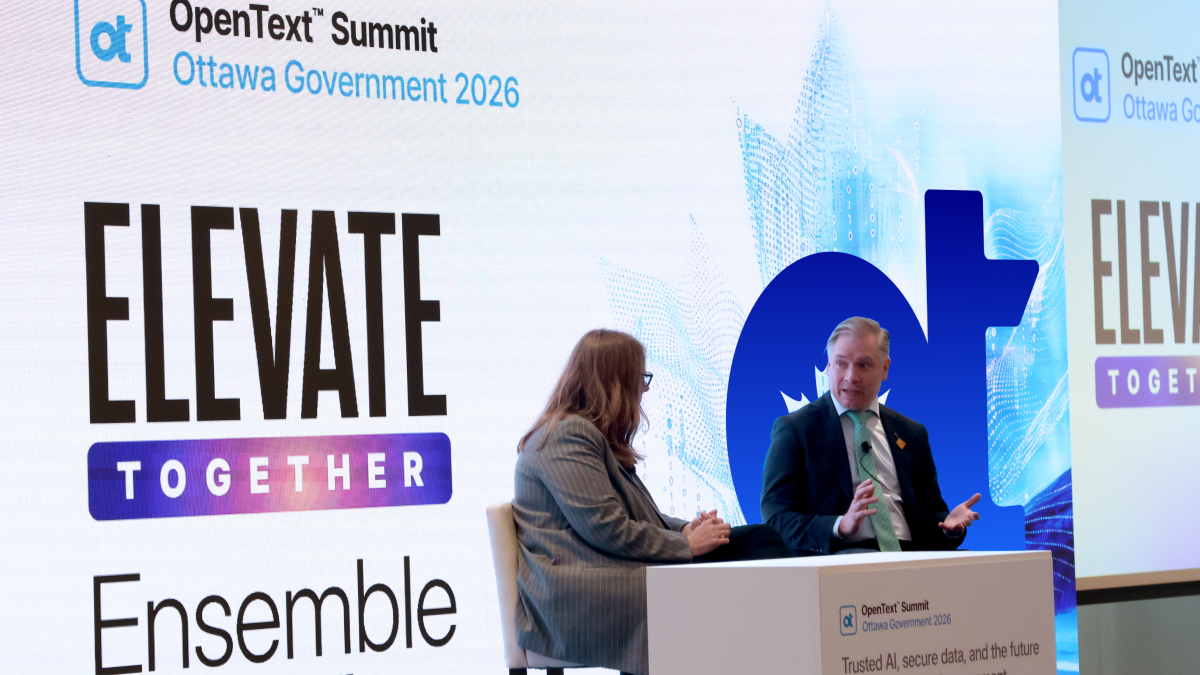
Schaan pointed out where industry can partner with government:
- To help tell good news stories about technology to counteract the AI doomsayers. “This will help define the AI moment,” he said.
- To help government identify where AI should be deployed. “We don’t know what we don’t know,” he said.
- To build strong relationships to figure out the future together.
Discussions around Protected B environments, sovereign cloud architectures, and secure operational platforms reflected growing recognition that governments must balance innovation with control and accountability.
Sovereignty does not equal solitude.
Mark Schaan, Associate Deputy Minister for Innovation, Science, and Economic Development, Government of Canada
One breakout session explored how AWS and OpenText are collaborating on next-generation sovereign cloud architectures designed specifically for Government of Canada requirements. The session framed sovereign cloud not simply as infrastructure, but as a foundational capability for what presenters described as the emerging “Sovereign Intelligence Era.”
The message was clear: sovereign digital government is no longer a future aspiration—it is becoming a core operational requirement.
Privacy, compliance, and accountability must be embedded from the start
As governments move from AI pilots to production deployments, concerns around privacy, accountability, and compliance are becoming central to adoption strategies.
A featured session with leaders from the Office of the Privacy Commissioner of Canada focused on how agencies can operationalize trusted AI while maintaining transparency and public confidence.
The discussion highlighted several emerging realities:
- AI governance cannot be retrofitted after deployment
- Privacy and compliance must be embedded into workflows by design
- Agencies need stronger visibility into how AI systems access and use information
These concerns are especially relevant as governments explore agentic AI and increasingly autonomous systems.
Schaan previewed the forthcoming National AI Strategy by highlighting six pillars, including the need to adopt frameworks that don’t lock in specific tools and the need for surge capacity to move “at the speed of technology.”
“We need to stop playing whack-a-mole, and move in a more strategic direction around AI,” Schaan said.
One of the summit’s most compelling discussions focused on identity governance in the “agentic era,” where AI agents can provision access, execute actions, and interact across systems with limited human intervention.
This introduces entirely new governance challenges:
- Who owns AI agents?
- How are permissions managed?
- How are actions audited?
- What controls exist to shut systems down if needed?
The session underscored that identity governance will become a foundational pillar of responsible AI adoption in government environments.
Darcy Pierlot, the Chief Technology Officer for Shared Services Canada, stressed the importance of “getting it right.”
“I deliver solutions and services across the Government of Canada,” Pierlot said. “Information around passports, immigration, retirement, social services–we house all of that data. We need to deploy systems that are still relevant and useful but also secure and responsible.”
Another highlight included a demonstration of OpenText™ Aviator™ Studio, where government agencies can create their own AI agents to automate tasks specific to public sector use cases and environments. With the right permissions, these AI agents can cross boundaries from SAP to Microsoft to OpenText to accomplish complex processes.
Unstructured content is emerging as a critical AI asset
Several sessions focused on a challenge many government agencies continue to underestimate: unstructured information.
Documents, emails, reports, multimedia files, and case records often contain the majority of institutional knowledge—but much of it remains inaccessible to AI systems.
Summit speakers emphasized that unstructured content is no longer simply archived information. It is becoming a primary input into AI-driven decision-making, operational workflows, and citizen services.
Breakout discussions explored how agencies can modernize legacy file shares and transform fragmented content repositories into governed, AI-ready information ecosystems.
This shift has major implications for government modernization initiatives:
- AI readiness increasingly depends on content readiness
- Governance and metadata become strategic capabilities
- Enterprise search evolves into enterprise knowledge activation
For many agencies, unlocking the value of unstructured content may ultimately become one of the most important steps toward responsible AI adoption.
AI success depends on operational integration
Another major takeaway from the summit was that AI cannot succeed in isolation.
AI initiatives must connect seamlessly into:
- Mission workflows
- Operational systems
- Service management environments
- Security and governance frameworks
This was particularly evident in sessions focused on AI orchestration and autonomous workflows.
Presenters demonstrated how AI agents can collaborate across systems to automate complex operational processes, dynamically adapt to changing conditions, and reduce manual effort.
At the same time, discussions around service management highlighted the importance of operational coordination across digital environments. Without integrated operational frameworks, even advanced AI capabilities risk becoming disconnected point solutions rather than enterprise-wide enablers.

The broader message was consistent throughout the summit: Responsible AI is not just a technology challenge—it is an operational transformation challenge.
From principles to practice
Perhaps the strongest theme emerging from the OpenText Government Summit Ottawa was the transition from principle to execution.
Governments already understand the importance of:
- Responsible AI
- Data governance
- Cybersecurity
- Public trust
The next challenge is operationalizing those principles across complex, real-world environments.
That requires:
- Connecting data and content across systems
- Embedding governance into AI workflows
- Ensuring transparency and auditability
- Building secure, sovereign digital foundations
- Activating institutional knowledge at scale
The summit demonstrated that the path forward is not about replacing existing investments. It is about connecting them into a unified operational fabric capable of supporting trusted AI and modern digital government.
As AI adoption accelerates across the public sector, agencies that succeed will be those that can combine innovation with governance, speed with trust, and automation with accountability.
Because ultimately, the future of digital government will not be defined simply by how much AI agencies deploy—but by how responsibly and effectively they operationalize it.
Learn more about OpenText Sovereign Cloud and AI solutions.