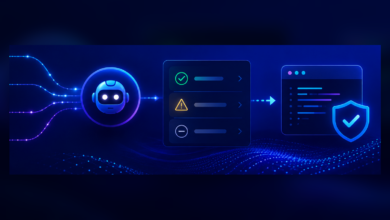
The AppSec bottleneck isn’t finding vulnerabilities. It’s everything after.
Why the vulnerability backlog keeps growing, what it costs in engineering hours, and why buying more detection won't fix it.


There is a live argument in security circles right now. If AI can write the code, and AI can review it, is traditional application security on its way out? It is a fair question, and the answer is no, though not for the reasons vendors usually give.
For years, the application security conversation has been about coverage: more scanners, more languages, more findings. Teams have gotten very good at finding vulnerabilities. Detection of true positives is still vital, but the harder problem, the one that actually determines whether risk goes down, is what happens after the scan finishes.
Finding the vulnerability was always only half the issue
Static and dynamic testing surface essential insights. At enterprise scale, they also produce tens of thousands of findings, and every one comes with the same set of questions: Is it real, or noise? Is the vulnerable code actually reachable? Does it matter for this application, in this context? Who owns the fix, and what exactly should they change? Answering those questions is manual, repetitive, and slow. The work often falls to a small team of application security engineers who sit between development and security. They become the bottleneck the moment finding volume outpaces the hours available to review them.
False positives are a property of the math, not a vendor flaw
Every static analyzer, from every vendor, produces false positives. To trace how untrusted data might reach a sensitive operation, dataflow analysis has to reason about paths it cannot always fully resolve: a sanitizer it does not recognize, a framework behavior it cannot see, or a branch that can never actually execute. Faced with uncertainty, a good analyzer errs toward flagging rather than staying silent. A missed vulnerability is worse than an extra finding to review. That noise is not a defect to be ashamed of. It is the cost of being thorough. But left unmanaged, it does real damage. It buries the findings that matter and slowly teaches developers that security alerts are usually wrong, until eventually they stop listening altogether.
The cost is measured in engineering hours
Put numbers on it. If a security review averages ten minutes per finding, a portfolio generating hundreds of thousands of findings turns triage into a full-time operation for a small army of people. Those are engineering hours redirected from building product into verifying scan results. And the hours scale with the size of the codebase, not the size of the security team. The backlog grows faster than anyone can clear it. Somewhere in that pile are the handful of issues that genuinely put the business at risk, indistinguishable from the noise around them.
AI did not create this problem. It raised the stakes.
It’s tempting to blame AI-assisted development for the flood of findings. But that is the wrong diagnosis. The triage and remediation bottleneck existed long before coding assistants. Teams have been outnumbered by their findings for years. What AI-assisted development changes is velocity. More code is written, by more people, more often, including by developers who are not security specialists and are moving quickly. More code means more findings, arriving faster than before. The gap between what you can detect and what you can act on does not hold steady as volume climbs. It widens. The same logic answers the bigger question. AI can now review code, not just write it, and that has people asking whether dedicated application security is still needed. But a general-purpose model flagging a bug in a diff was never the hard part. Governing findings across an entire portfolio, proving coverage, enforcing policy, keeping an audit trail, and clearing the backlog at scale is the hard part, and that work grows as AI writes more code, not less. More AI, on its own, does not fix application security. Applied with governance and a human in the loop, it does.
This is a scalability gap, not a coverage gap
The reframe matters because it changes where you invest. Buying more detection, whether through traditional SAST or Agentic AST, does not fix a triage bottleneck. Neither does shifting left on its own. Moving the scan earlier in the pipeline surfaces findings sooner, but it does not reduce how many there are or how long each one takes to assess. Adding headcount does not scale either, because the work grows with the code, not with the team. The organizations pulling ahead are the ones automating the work between the scan and the fix: determining what is real, explaining why in terms a developer can trust, and helping get to resolution without turning every finding into a research project.
The next evolution of application security is not just about finding more. It is about acting faster and more accurately on what you have already found. That is a very solvable problem. The rest of this series will show you how.
This is part 1 of a three-part series on the application security triage bottleneck. Read the rest for the full picture:
Part 2: 3 million minutes back: putting AI on the AppSec backlog — How AI closes the gap, with results from a deployment across thousands of applications.
Part 3: Audit every finding, fix what’s real: inside Fortify Remediation Aviator — The product that does it, including new SAST/DAST correlation.