The AI-powered security operations center (SOC)
How the OpenText SIEM AI Bridge helps analysts work smarter


There’s a familiar moment in every SOC shift. Everyday security analysts sift through alerts, jump between dashboards, and write complex SIEM queries just to figure out what’s worth investigating. An AI-powered SOC can help.
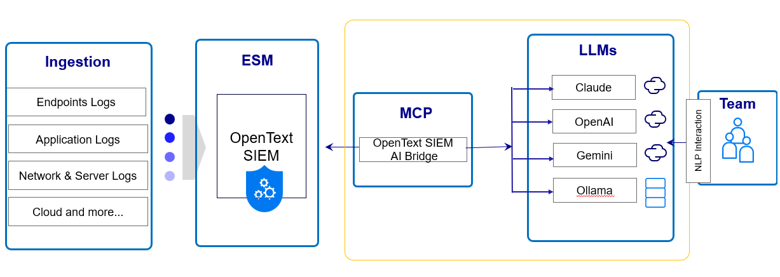
The OpenText SIEM AI Bridge tackles this head-on by connecting OpenText Enterprise Security Manager (ESM) to large language models, letting analysts investigate using plain natural language instead of manual queries.
What AI Bridge does
The AI Bridge acts as a translator between analysts and the SIEM. Ask a question in plain English — i.e. “show me failed logins for this IP” — and it retrieves the data, correlates it across alerts, and returns a reasoned, summarized answer. OpenText ESM stays the source of truth, and role-based access is fully enforced.
Why local LLM support matters
The Bridge isn’t locked into one AI vendor — it works with Claude, Gemini, OpenAI, or Ollama running locally or air gapped. That local option is huge for security teams: sensitive event data never has to leave the organization’s environment, making it a safe, low-risk way to start an AI adoption journey without rearchitecting infrastructure or sending data to the cloud.
The working AI-powered SOC
Getting started in four steps
- Getting up and running is straightforward. Import the OpenText SIEM_AI_Bridge.arb resource bundle into your OpenText ESM environment.
- Next, copy the OpenText SIEM_AI_Bridge file to the host machine where the MCP server will be deployed.
- From there, set up and verify connectivity with OpenText EM.
- Finally connect any MCP-compatible AI client to the OpenText SIEM AI Bridge server.
That’s it — no rearchitecting your stack, no ripping out existing tooling.
Seeing it in Action: Claude & Ollama
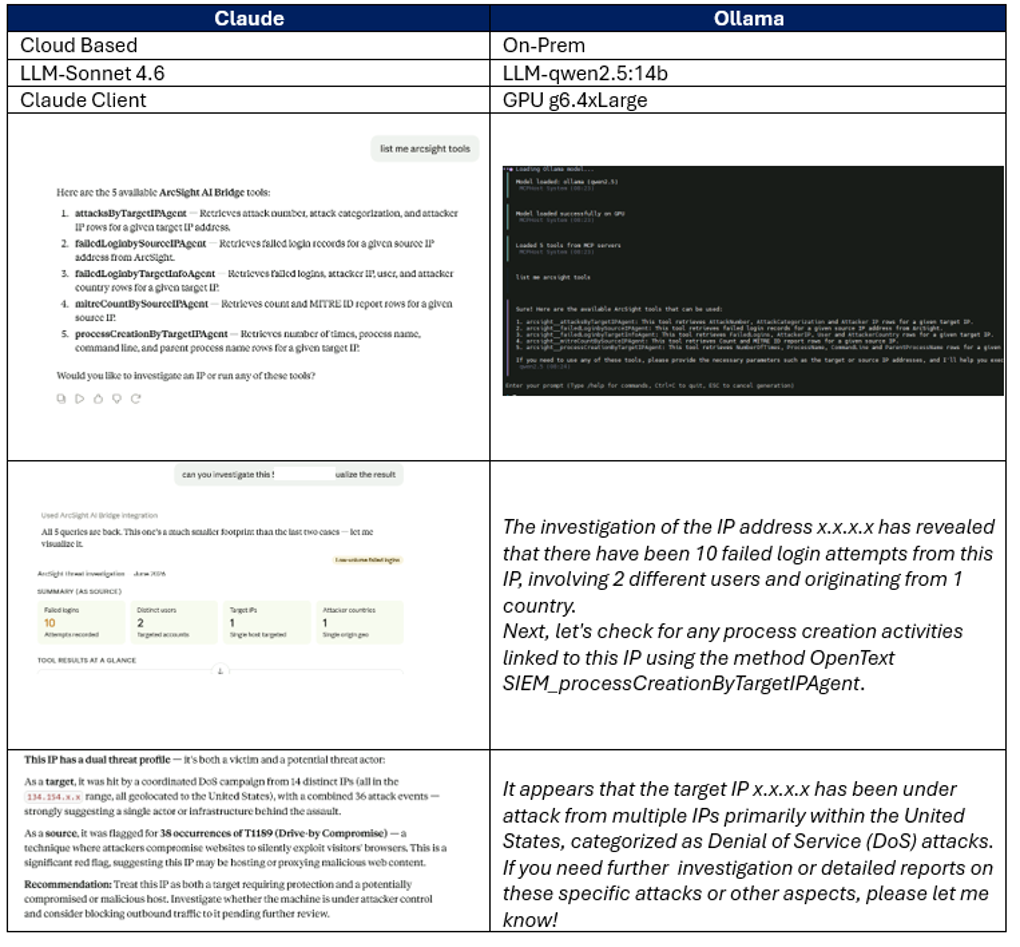
To demonstrate the AI Bridge in a real-world context, we ran it against two different LLMs side by side — Claude (cloud-based, Sonnet 4.6) and Ollama (on-premises, qwen2.5:14b on a GPU g6.4xLarge instance).
Helping with the AI journey
By layering AI reasoning on top of existing SIEM data instead of replacing it, organizations can pilot generative AI in a way that respects governance and compliance requirements already in place — a practical first step toward broader AI adoption.
Helping analysts, not replacing them
The real win is for the humans in the SOC. Automatic correlation, reasoned summaries, and clear prioritization mean less time hunting and more time deciding. This new capability cuts Mean Time to Investigation, reduces analyst fatigue, and even surfaces attacks standard rules miss, since the LLM reasons over context instead of matching fixed signatures.
Learn more and get started: OpenText SIEM AI Bridge | Cybersecurity Marketplace