

Customer acquisition is only the beginning. In this revealing keynote from OpenText World 2025, OpenText Customer Experience leaders unveil how the future of CX hinges on connected conversations that span every channel and touchpoint. Through fireside chats with Citizens Bank and The Standard, you’ll discover why 90% of newly acquired customers churn when post-acquisition experiences fall short—and how OpenText Experience Cloud solves this through unified communications, journey orchestration, and AI-powered design. Watch as they demonstrate real-time interactive customer messaging, Figma-to-CMS automation that reduces weeks of work to seconds, and the roadmap for bringing your own LLMs to create truly conversational customer experiences.
Watch the keynote video or scroll down for the complete transcript

OpenText World Customer Experience keynote video transcript:
Colin Brown (Head of OpenText Digital Experience Business Unit): Thank you for coming today. I really appreciate it. My name is Colin Brown. I’m the new head of the business unit for digital experience, and I’ve been here about five months now. The speakers today include myself, Janet, and Guy, and we’ll have a couple fireside chats. So in the last five months, I spent a lot of time talking and visiting with customers, visiting our engineers, developers, product managers, and just really doing a lot of listening.
So today, I have a super simple question for you, and that question is “What if?” What if your customers could ask a question and get the right outcome every time, everywhere they interact with your business? What if you could understand the question and sentiment, know where customers are in their journey in that conversation, present answers in the customers’ channels of choice that they’re talking to you in, and we take all that information and give you relevant answers. That’s part of what we call a conversation. And conversations are the new digital storefront.
Now you might say, hey, Colin, what do you mean it’s a new digital storefront? We’ve had digital storefronts forever. We’ve had conversations forever. And they started with just what we’re doing today, talking back and forth. And then thousands of years ago, we invented the alphabet and we could write messages—not a lot of messages, but some messages—and share those out. Hundreds of years ago, it changed with the printing press, and you could send thousands of the same message out. Whether it’s a good message or a bad message, that’s a whole other story, but you could send a lot of these messages everywhere.
And then about roughly 100 years ago, radio happened, and then you could have these conversations from one person to many all over the place, over long distances. And then around 70 years ago, television came out and you could have moving pictures sending messages back and forth. And it was like that for a while, and then about 30 years ago, this little thing called the World Wide Web happened. Any of you use that today? Yeah, it kind of revolutionized everything. And then during this whole time, the conversation on print that you had changed from print to digital, which also increased the pace of conversations and changed the way it happens. And then in the last 20 years, social platforms have happened. That’s all my kids use these days. And now, because of all this, the conversation is more important than ever.
So conversations are the new customer experience and it’s conversational. Let me give you an example of what happens here. So I arrived Sunday night in beautiful Nashville, my second time I’ve ever been here. And I’m a big football fan, so I wanted to watch my Super Bowl champion Eagles play football on Sunday night. So a year ago, how would you have found a good place to go watch your team play? You would have logged on to Facebook—if you’re old, like me, and still have Facebook—or Instagram, or use Google Maps to find a sports bar that supported your team.
But today, I loaded up my AI agent app on my phone and I said, find me—I did say it in a nice way—find me an Eagles sports bar in the area, and it came back with three choices and it said, would you like me to show you the one closest to where you’re staying, because it knew exactly where I was staying, what my plans are, and that I don’t like walking a lot, apparently. So I said yes, and then it gave me directions to three different ones, including the closest one, and I went and I got to watch my Eagles win—and still number one seeds in the NFC, for anybody who’s a football fan.
But that type of conversation is completely changed. It’s conversational. And what that AI agent did was it looked at all the available sources—social media, websites—and built an answer in the conversation for me that I was looking for. Some of these websites for the bars were more optimized for AI than others. But they were part of the conversation, and they didn’t even realize it was happening. So I find that really interesting. And you see, today, everything’s changing.
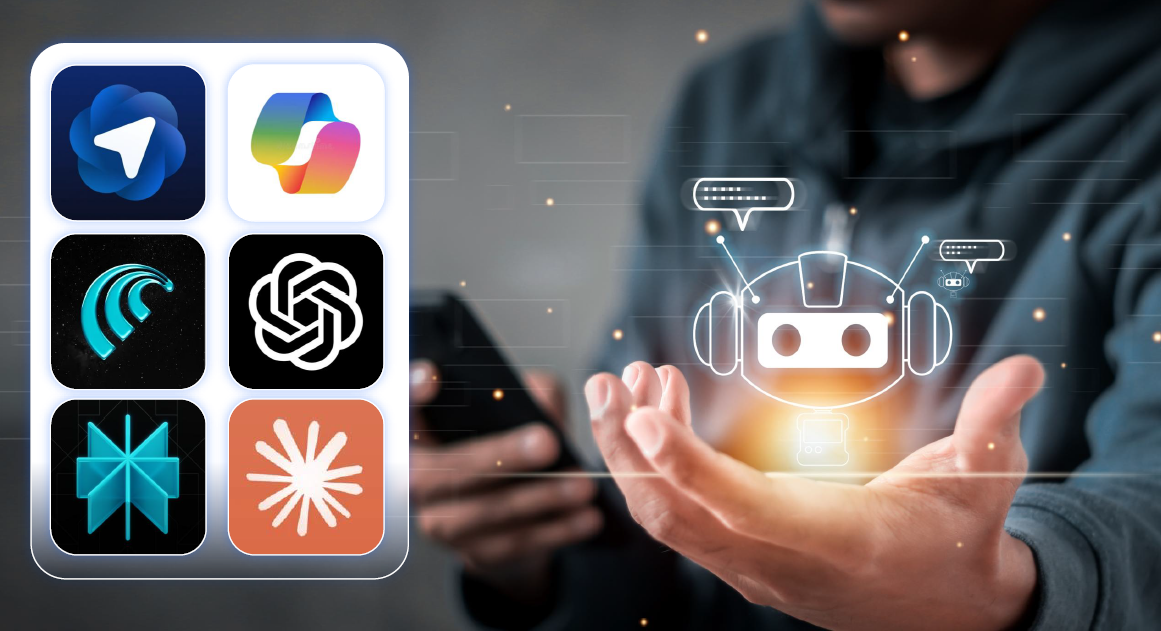
In a world of AI-induced disruption, customer experience is changing and the winners will be the ones who adapt to control it. Disruption is everywhere—new channels, new competitions, new ways of engaging. But it is all noise. It becomes crystal clear, customer experience is now the ultimate battleground. That’s why today, the keynote is about taking control of the customer experience and shifting the way that we control this disruption.
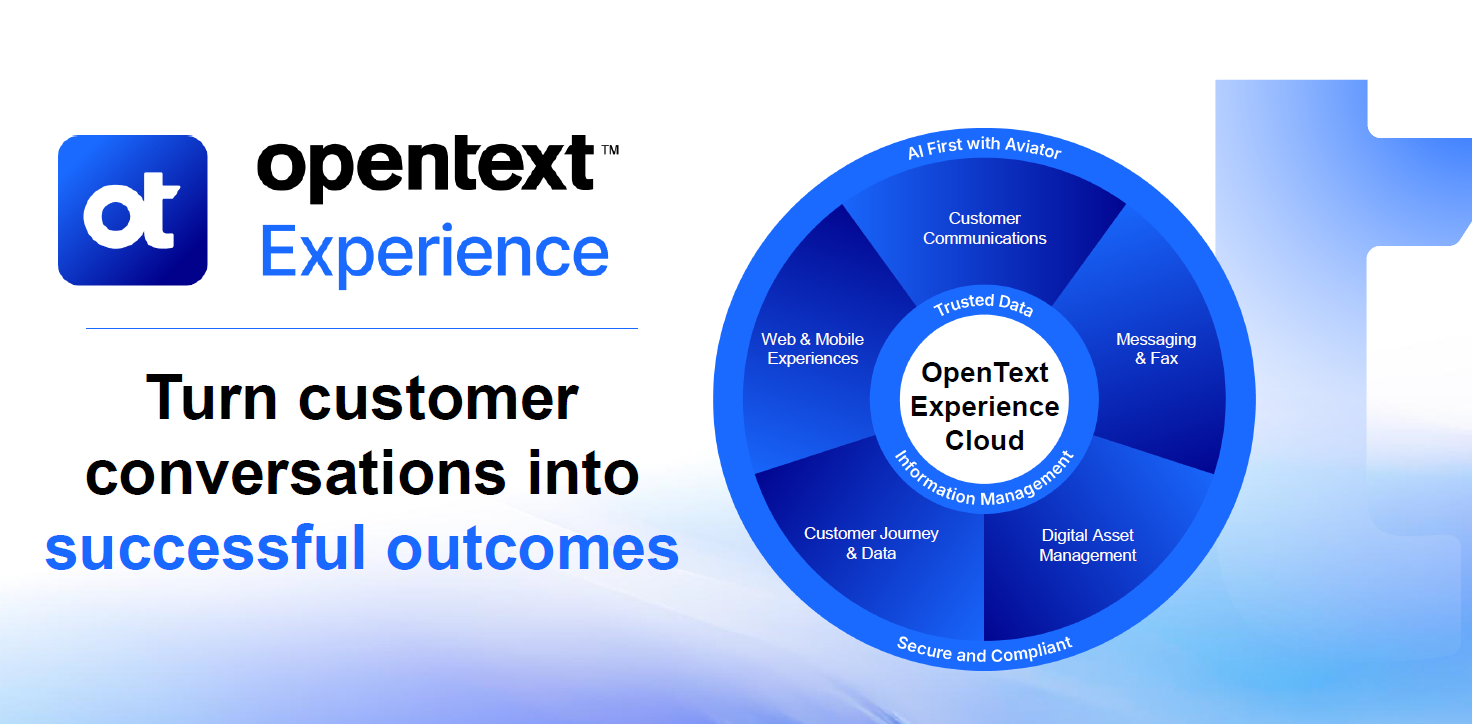
So we’re going to do that, and we’re going to show you how with the Experience Cloud, because it turns customer conversations into successful outcomes. So the Customer Experience Cloud is comprised of all the components you know and love from the Experience product line today. It’s communications to engage with your customers. It’s channels of all the channels you need, but it’s also the channels that you don’t know you need. You shouldn’t worry about the channels anymore. The customer worries about the channels. It is digital asset management to take care of all your assets for those communications when you communicate. It’s customer journey and data so you know where the customer is in the path of their conversations, and it’s web and mobile experiences all wrapped together in the beautiful platform of OpenText.
Fireside Chat with Citizens Bank: Conversational customer experience in Banking today
So I painted a little picture here about—a scary picture of what the future is. I’m going to bring someone on stage right now who is living this on a day-to-day basis. Please welcome Chris Herring, SVP of digital experience from Citizens Bank.
Colin Brown: Have a seat. So, Chris, tell us about yourself.
Chris Herring (SVP of Digital Experience, Citizens Bank): About my—oh, you didn’t prep me for that one.
Colin Brown: It’s a tough one, I know.
I’ve actually spent a career in content, so I started working for a newspaper publisher out of college, and then figured out their website, built ad networks to compete with Google, and then figured out how to sell digital advertising locally. And we were disrupted at that point in time by iPhone apps, aggregators, Google search, to the point in which my newspaper company went bankrupt and was bought by a hedge fund, of which we then transitioned and created more products from there.
Colin Brown: That was from an industry that got disrupted?
Chris Herring: Yeah, completely. And then went on to the agency world to consult through all of the ad tech disruption that really changed that space, and then sold content management services and eventually into a bank to do it. So if I’m going from most exciting to least exciting or if I’m switching places, but yeah, I’ve spent my whole career here.
Colin Brown: Yeah, that’s great. I mean, I, myself, I also grew up in a telecommunications world, a world of constant disruption all the time.
Chris Herring: Of course, yeah. It’s very similar.
Colin Brown: So tell me about the modern customer experience in financial services these days. What’s that like?
Chris Herring: I think when we talk to our businesses and product leaders, it’s really a focus on immediacy. So the demand is that I’ve identified a customer problem and I want to solve it, or I have a customer conversation that needs support and I want to have that conversation. Or we have a new product offering or an opportunity to improve a customer experience, and we want to do it immediately. So I think that that’s where the demand—that’s the demand I see.
And I think what we’ll probably get into is that there’s not a tolerance to say, OK, well, that’s great. You’ve identified that problem. Let me go spend three months building the perfect communication or the perfect digital experience to solve that problem for your customers. This concept of immediacy is, I think, driving a lot of what we do, and honestly, the interest in AI and what it can do for us internally.
Colin Brown: That’s great. So conversations are the new customer experience. How does that resonate with you and what you’re doing?
Chris Herring: Well, it’s interesting. I see all the slides and I always think, whenever I see words like “conversations” with you, in the business, and the customers want to talk to you, I mean, I see it a little bit differently right now. I think we’ve all indexed on focusing on operational efficiency because our businesses are talking, if you’re a public company, to the street about that. Or internally, that feels right. Let’s build agents and let’s operationalize and drive automation.
But I think about it in the terms of the customer’s relationship with us is changing in a way where there’s probably a lot of things that you all do with banking that you probably don’t want to talk to your bank about. You just want it to happen or you want to be able to do it. And we’re seeing—maybe not directly seeing in a really quantifiable way, but we’re starting to hear of use cases of which customers are asking ChatGPT, can you do this for me? Can you tell me what products that I have? Tell me what the rates are. That’s a common one I do.
So if you’re shopping for products, you’re seeking information. But a lot of customers, I think, are going to expect that they can service their banking relationship without calling the bank. So I think conversations for us is—I use the word “influence” a lot, is how do we influence the conversations that maybe happen outside of us? So your Eagles example, how did those bars influence AI to recommend to you that person, looking in that moment, for that experience, whether it’s through imagery, visual content, context that you offer that. So I think that’s really the challenge we’re up against, is influencing conversations that are happening off us.
Colin Brown: So how are you seeing that with your customers in the financial industry and your stakeholders internally? How do they see the website or the interaction not being direct with them? Are they OK with that? How are they taking on that new approach?
Chris Herring: I mean, I don’t think we’re fully under—we don’t fully understand it yet. I think there’s, to us—I shared with you when we first chatted, is for me, it’s an “and” situation. So I still have to deal with customers on a daily basis that interact with my products, come through my websites, interact with our digital service experiences through our mobile apps and online banking. We have to still provide an amazing customer experience in that way.
But then we have then these experiences that are happening off us and we have to rationally figure out, really, at a use case level, do we want to enable that? Do we want to influence that experience? I think it’s easy to think about it in the context of information sharing, like your example, or me asking—I’ve just moved to a different house and I’m trying to ask questions about home improvement things to my ChatGPT, and that’s an informational gathering stage.
But then you move into recommendations and then you eventually move into task assistance. Would you like me to start that application for you? And then you go all the way to the extreme far right of automation. And I would say, from a customer segmentation perspective and a trust perspective, there will be certain use cases, behaviors, segments that are going to want to fall somewhere on that spectrum. So we have to figure out how to deal with that in a very flexible way. So that’s a lot of what we’re talking about, is just ensuring that the platforms and the infrastructure and the data structure we’re building is flexible enough for whatever the customer needs end up being.
Colin Brown: What would you say to people in companies that are not having this conversation yet?
Chris Herring: So I would get really provocative or set some structure of which you can have provocative conversations about customer behavior change. Challenge yourself to think about—usually, we talk about things like, well, let’s build a better mobile app experience so that we can improve customer satisfactions and interactions and make it easier and better to do banking. Propose questions like, well, what if the customer doesn’t come to the app? What will we do if the customer doesn’t read email?
There’s a very—I’m already doing this in some examples in my personal life, where I’m having the AI go read my email for me.
Colin Brown: How’s that working out for you so far?
Chris Herring: Well, it actually works all right. I mean, if any of you have Copilot and you’re using Microsoft 365 and have access to the current—the highest level AI version, I mean, it’s reading your email and summarizing it for you. So think about what would you do if you had to send an email to AI and not to that person? And obviously, we think about it in human terms. We don’t just think, oh, let’s send an email to a machine. But if I have an assistant acting on my behalf, how do I communicate to the assistant so that it can assist its customer?
And so I think creating a safe space to have provocative questions about that, like how do we build a business? I asked you the other day—or maybe I made a statement. I said, well, I don’t want my users to even be in your platform. You’re designing this great UX and I’m going, cool. Well, I don’t even want to experience. I want all the features and capabilities and functionality, but I don’t want to have to have specialized users in your platform.
Colin Brown: Yeah, that was great feedback.
Chris Herring: That’s a good way to think about it.
Colin Brown: It was interesting you mentioned the shopping piece earlier. So last week I went early holiday shopping with my wife for my daughter, who’s a horse girl. She spends more time at the barn than at my house. My wife found a 3/4 zip sweater that she wanted for my daughter, but it was in the wrong color. And so my wife said, oh, I wish we could have this in the purple color. She looks at me and goes, go find it. And what do I say? Yes, dear.
So what I did was in the past, I would have maybe walked up to the store and asked them if they had it. They probably would have said no. I scanned the tag and the AI agent came back and said, hey, you can buy this in the color, which wasn’t actually called “purple.” It’s called something else I don’t remember the name of right now, but some purple variant. And it said, you can buy it at these three places online. And what was interesting is the store we were at actually had an online website, but they were clearly not optimized for AI, so they lost a sale in that conversation they didn’t even know about.
Chris Herring: I would just add, I think the challenge for me, as a platform leader, especially in the DX space or the experience space, is trying to figure out how we’re going to piece together all the contextual information about our business, our operating procedures, our servicing experiences, literally documenting digital experiences in a way that we can enable an AI assistant to navigate those experiences in a meaningful way. And as you can imagine, as a banking institution, we’ve got to think about access controls, governance.
I may be OK with allowing AI to consume all my public web content, but if I want to then enable for certain use cases that it could let’s say, start a credit card app, I may want to first understand who that agent is acting on behalf of before I enable that. So we call them “context systems,” but I think that figuring out how, for the last presentation I was in this room where you’re going to mix these ECM systems with CMS systems with your data systems in a meaningful way, where there’s semantic layers and context effectively to allow these machines to operate on behalf of their customers is a new paradigm for us that I don’t think any of us really know where that’s going to land.
Colin Brown: That’s great. So with the ten seconds we have left, a year from now, what does success look like for you, in a few words?
Chris Herring: Maybe I’m managing a staff that’s three to four times the size it is today, but it’s full of digital agents and digital workers to assist my current talented staff and knowledge workers. So maybe that’s a good goal to have.
Colin Brown: Great. Well, thanks, Chris. Appreciate it. Thanks for coming on.
Chris Herring: Thanks.
The top 5 customer experience insights from OpenText World 2025The state of customer experience today
Colin Brown: All right. Now to talk about the state of CX today. Please welcome on Janet De Guzman, Senior Director of Product Marketing for Digital Experience at OpenText.
Janet de Guzman: Hi, everybody. My name is Janet de Guzman. For those of you who don’t know me, I lead product marketing for the Experience business at OpenText. Welcome to OpenText World. I hope you’re having a wonderful day one.
I’d like to start with you folks by telling you a story that hits close to home. A leading US healthcare provider came to us with a shocking problem. They had invested quite heavily on technology for customer acquisition—so they built out new campaigns, added some new channels—and it worked. It worked really, really well for them. So a lot of sign-ups came. It skyrocketed. But after 12 months, shockingly, 90% of those new customers left. 90%.
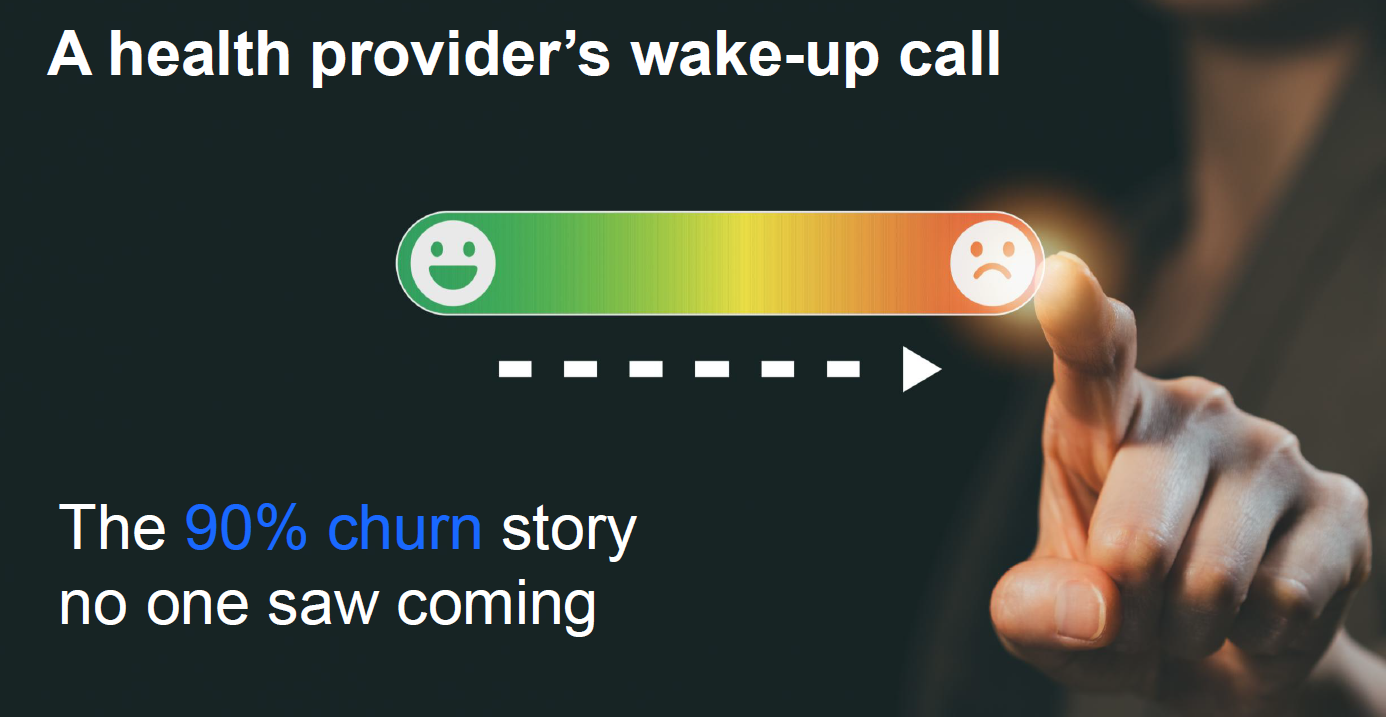
That organization experienced something that we call the “acquisition trap.” They optimized everything for the front door, but they didn’t think about everything that happens after it. And so we worked with them to redesign their post-acquisition customer experiences. And what happened is that improved not only customer churn, but they won back customer loyalty and retention and trust. Because in today’s world, everyone, when a customer buys from you, it is only the beginning.
And that’s not just one organization’s story. Really, this is true across all industries. Research tells us that the majority of companies are now competing primarily on customer experience. Less so on price and on product, primarily on CX. However, despite that awareness, as you can see here from PWC, over 50% of consumers have said they have abandoned a brand after just one bad experience. So that could be maybe perhaps you or me doing that.
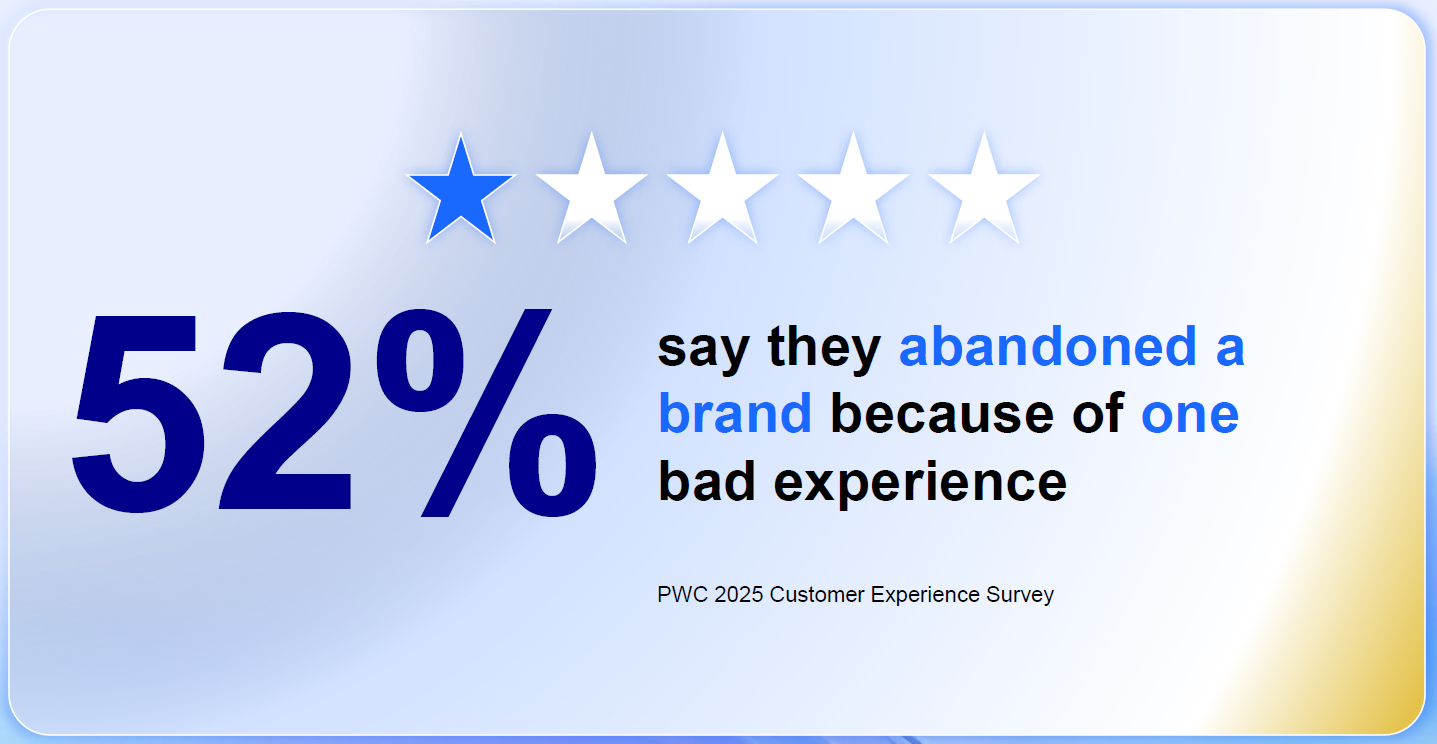
We have very little margin for error now. It’s never been thinner. One broken journey, one missed message, one disconnected interaction can erase years of brand equity. The front door is only the beginning. And because of that, it’s not just about winning a customer. It’s about winning them over again and again through positive experiences.
When we speak to organizations today, we ask them, how are you doing with post-acquisition experiences, and they say, we struggle with this and these are the top reasons that they told us. One, they are awash in customer data. The data is not a problem. They just have the inability to derive insights from them. They say that their teams all have the analytics, they have the dashboards, they have the reports, but that information is not connected and it’s not easy to understand the whole customer. Nobody can see the whole customer. So it’s not about more customer data. It’s about connecting it with action.
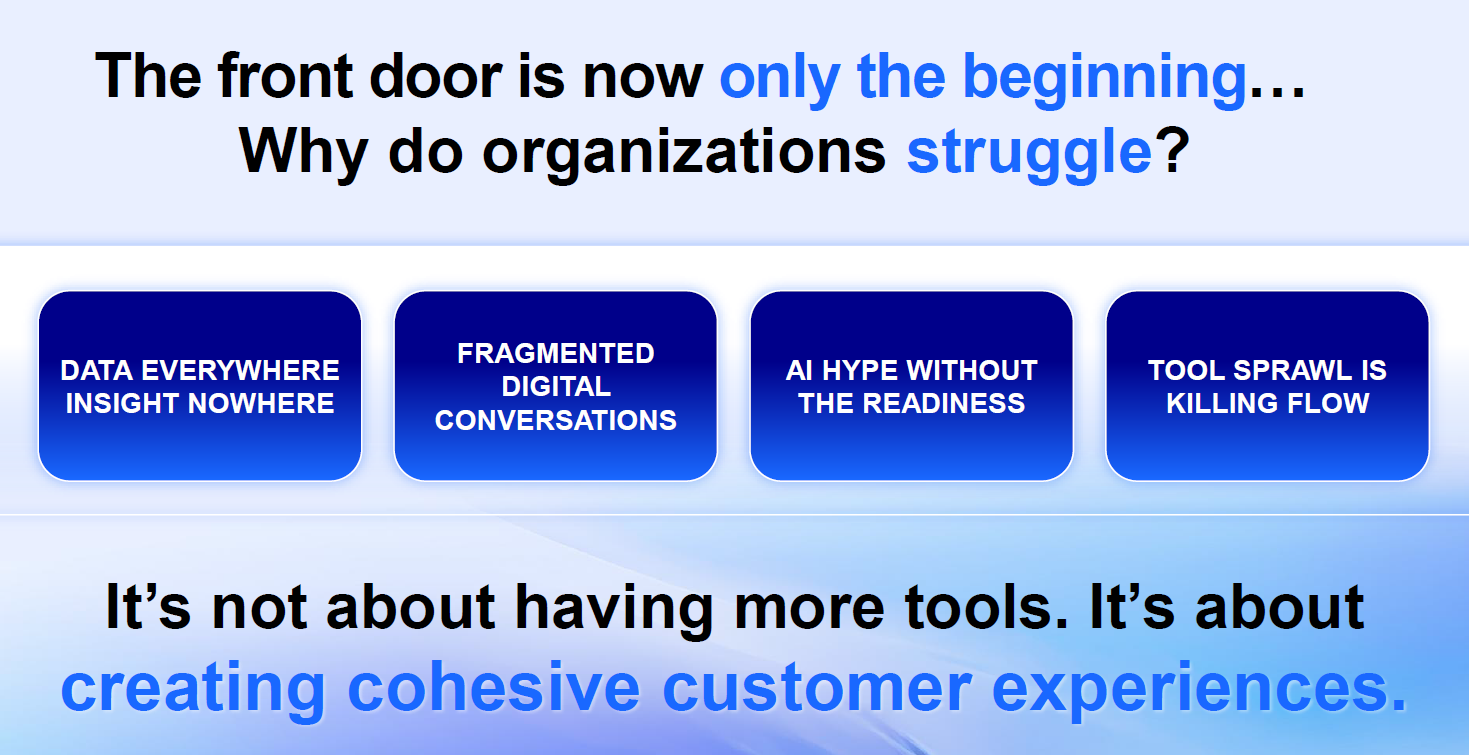
Secondly, customers don’t see you as departments. They see you as a brand. And customers may interact with as many as five or more functions in an organization, yet it is rare that all of those conversations are connected into a unified experience.
AI, it’s everywhere. It’s amazing. It’s always in headlines. It’s so exciting. You heard all about it in the keynotes this morning. But many organizations—maybe yours—are still grappling with the question, are we ready? What do we need to do to be ready? What do we do to start? So this is the challenge that we’re hearing about, is that without clean data, without a clear governance structure, without the right use cases, AI is just a promise and it’s not going to become a reality.
And finally, many organizations have really out-tooled themselves. There’s a different system, a different platform for every team. Every process has a different stack, and instead of this helping to speed things up, it’s actually slowing things down. The result—disconnected systems, inefficiencies, and a lot of duplicate work. So these challenges, everyone, they aren’t just technology gaps. They represent connection gaps. And to solve this, we must connect data, content, and conversations. And to share and to show you how Experience Cloud can do just that, I call back up Colin and I introduce Guy.
OpenText Experience Cloud Demos
Colin Brown: Thank you, Janet. So the Experience Cloud, Guy Hellier, VP, Product Management at OpenText, is going to take you through it. But it’s a unified platform that will solve all our needs. So Guy, take that.
Guy Hellier (Product Leader): So yeah. So great setup by Colin, Chris, Janet. And I think, as you’ve seen here, the Experience Cloud is a platform. It’s a cloud platform. It’s a setup of composable, modular capabilities that do work together—
Colin Brown: That everybody in the crowd uses portions of that.
Guy Hellier: That’s right. That’s right. And so the Experience Cloud is—in order to achieve that vision of the conversation as the digital storefront, there’s a lot of things that have to happen and that have to happen really well for that conversation to be supportable, be natural. Whether it’s in an external AI agent, whether it’s happening on your own digital properties, it’s got to happen in both places. The channel doesn’t matter, but it all matters. So all the channels matter.
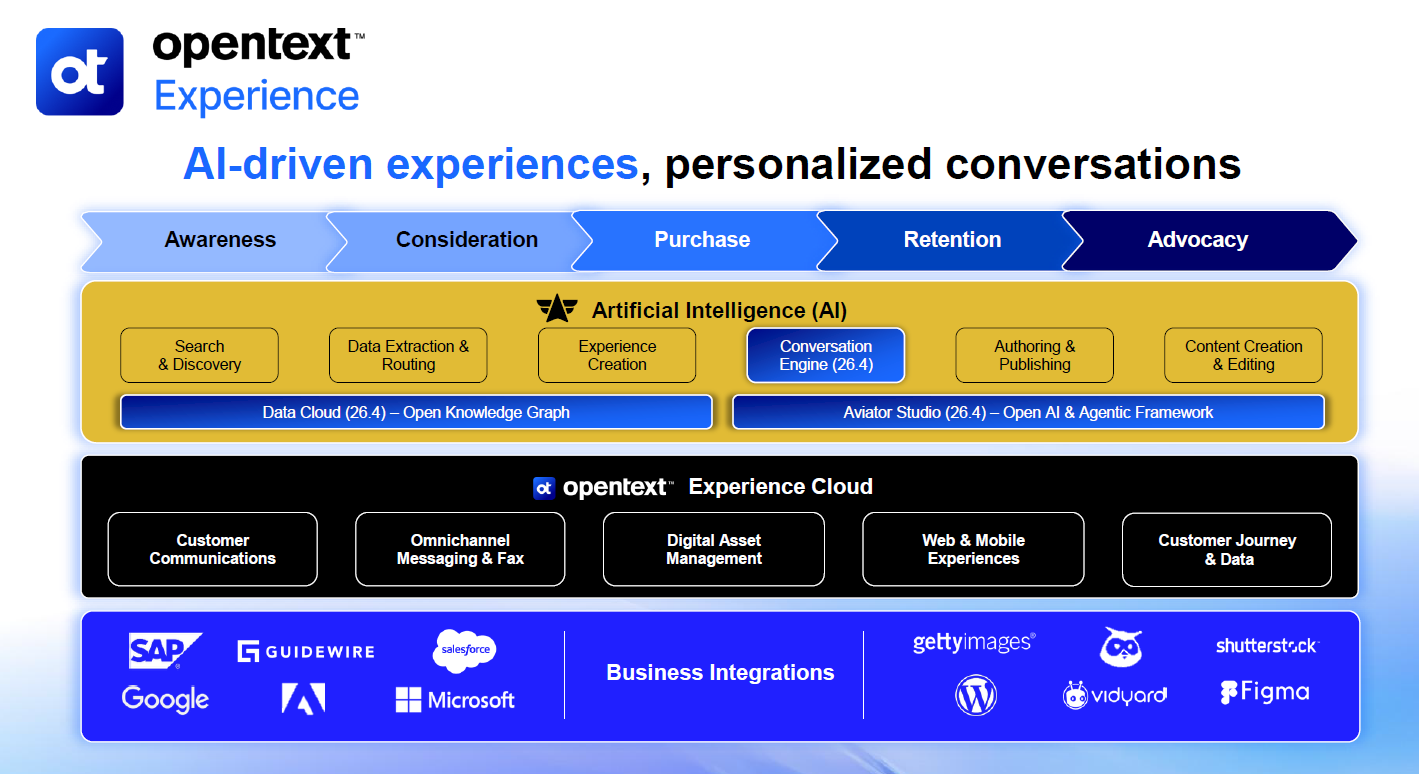
And so that means when you look at our Experience Cloud and the layers of the Experience Cloud, you see in black there, you see the main components that we provide—the customer communications, the channels, the messaging channels and even, yes, fax—in the B2B world, it is a messaging channel—digital assets, the digital experiences themselves, and then, of course, the journey data. And we’re going to show you more about the journey and the context of the customer experience. That’s what journey is all about.
So for the conversation to happen, the AI layer needs a new conversation engine. And we’re very excited about what you heard this morning from our chief product officer, Savinay Berry, about the open knowledge graph, which is going to actually bring the information together in a schema that actually can be used and executed on. And then to also bring in the Aviator Studio, which gives you the low code, no code agentic tools to actually automate. So we’re bringing this into the Experience Cloud to enable these conversations. And, of course, it all has to integrate to the ecosystem that you see down there, on the bottom.
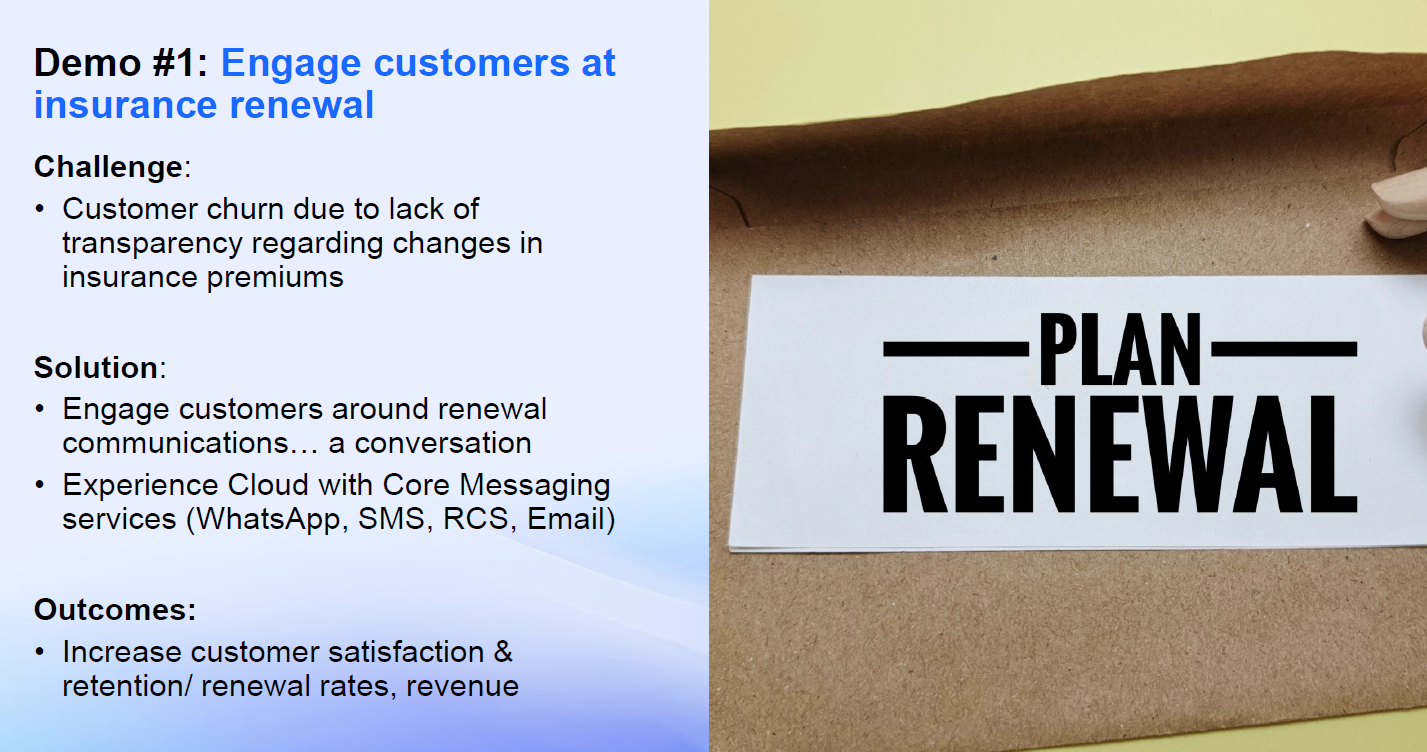
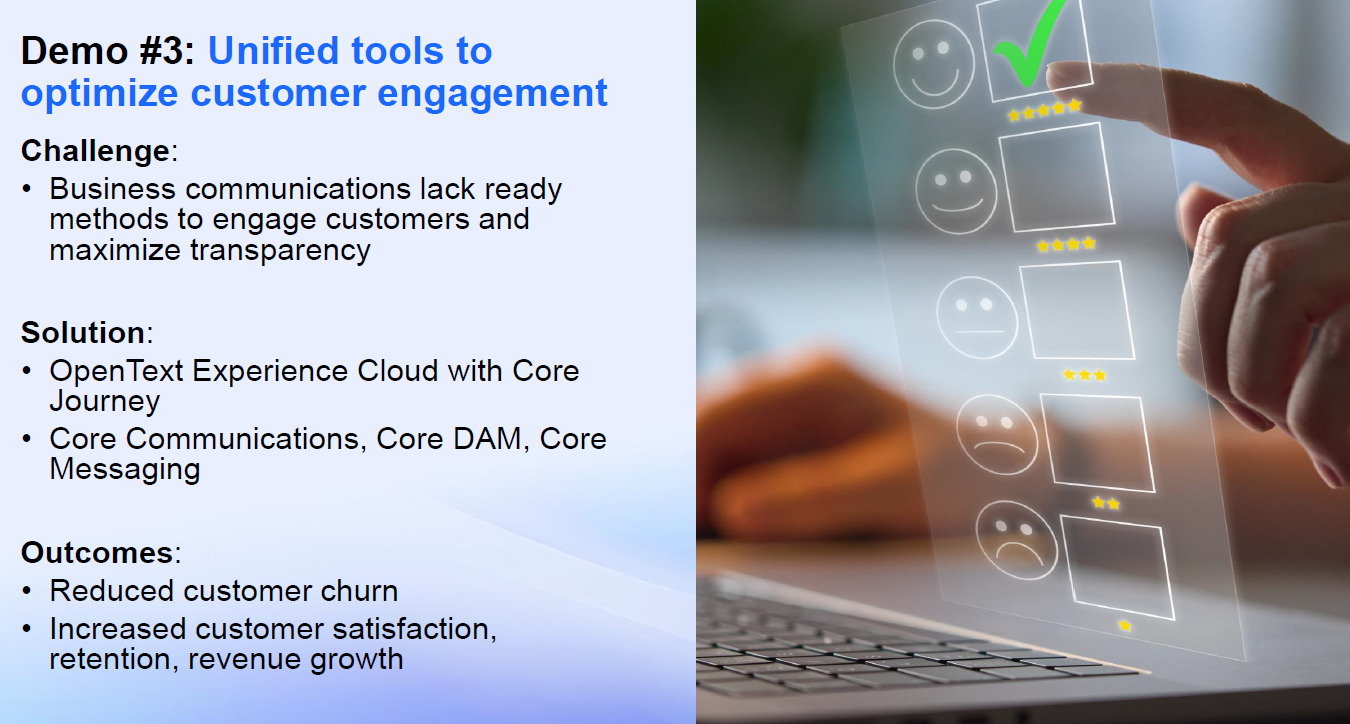
So I’m going to take us through an interactive demo here. And so I would ask, if you are a WhatsApp user, by the way, please pull out your device. I’m going to invite you into an interactive demonstration of a conversation. So the demo is going to be—so we’re going to start out with engaging a customer at an insurance renewal, a point of an insurance renewal. Then we’re going to look at delivering a digital experience that might be part of that conversation, the point of renewal, and then we’re going to bring it all back together to show how the tools have worked together.
OK, so the setup here, I think we all have insurance products of many different types. If you think about property and casualty, one of the biggest challenges at renewal time is that as a customer, your premiums may have gone up. And so this represents a really precarious time in the customer relationship because if your premiums have gone up and you don’t understand why, that’s a prime moment for the customer to churn. So guess what? A conversation may be needed. What’s the conversation about? What’s happening in my premiums? As a provider, how can I help the customer understand that better?
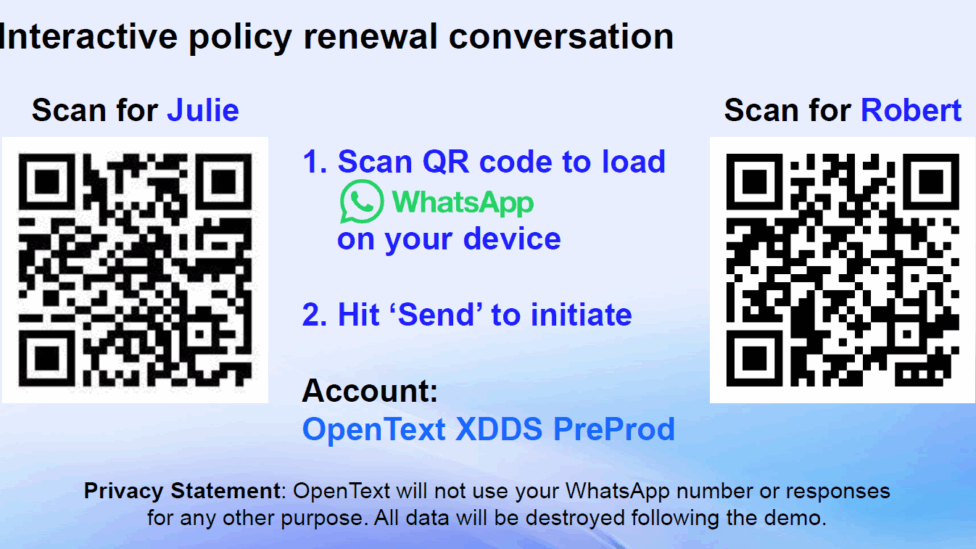
And so what we’re going to show here is just a very—it’s just a very audience participation demo. So if you have WhatsApp, we’re going to show just a two-way conversation. I wouldn’t say it’s conversational, so I don’t want your expectations to be way up here. But just the nature of an interactive, two-way conversation. So I would ask you to choose if you want to be customer Julie or customer Robert, just scan the QR code there. And what that’s going to do is just going to load up your WhatsApp. It’s going to preload a message. Either it’ll say either “Julie” or “Robert.” Just hit send on that and you’re communicating.
Colin Brown: Guy, let me ask you. So we’re doing this on WhatsApp. We talk about the channels not mattering. Will this work in RCS when the US carriers get it resolved?
Guy Hellier: Absolutely, absolutely. And the great thing about RCS and WhatsApp, of course, is that the messages you’re going to get back, they are a tiny—they’re a micro experience, so it’s something you can click on. And if you can flip over to my screen here, I just have it loaded on the laptop here. So here’s the initial message you got would have been, in the case of Julie, Julie is renewing for her 10th year, and so there’s a loyalty journey that we have here. But I can click on “Yes, please,” I want more information, or I could have opted out. No, I’m aware. You don’t have to—I don’t need to hear any more.
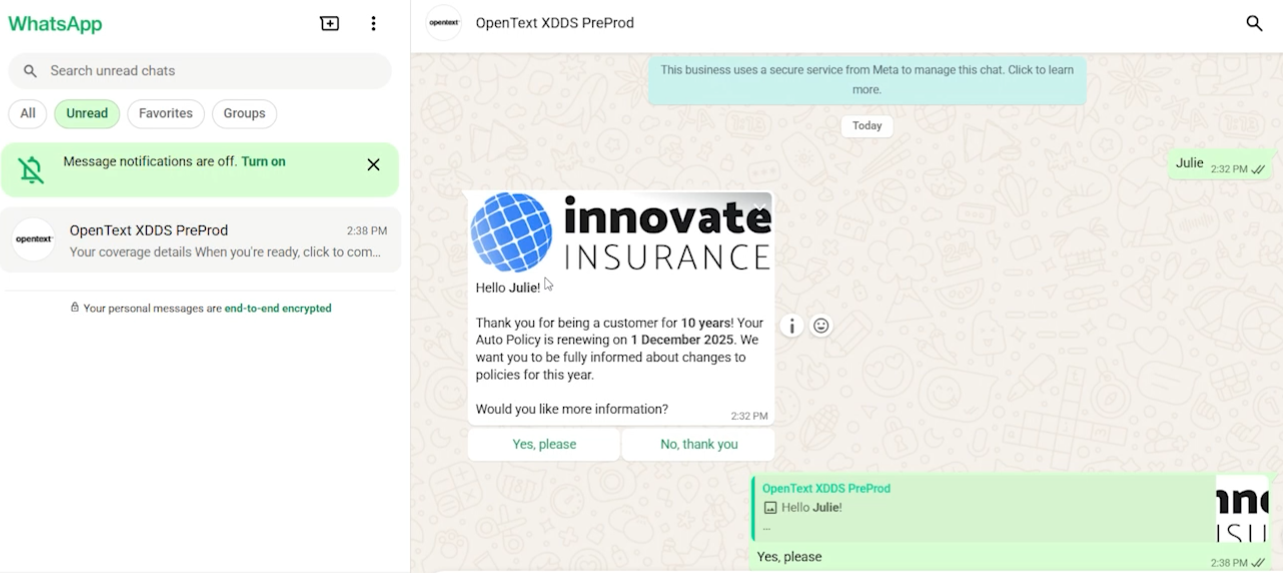
But then we’re responding with video, digital assets, so being able to bring digital media into the conversation. There is an email that will have been generated. And so that email for Julie will be personalized. It’ll have personalized information. This is just a simulated delivery of that here. And then I can click to go to the website to complete that renewal. So there are lots of things that can be happening together, all altogether, and, of course, interactive two-way messaging makes that conversation easier.
Of course, where we’re going to, that conversation will be free-flowing. It will be all driven by large language models. And so we’re going to come back to this. And so for those of you—I saw lots of folks who—and you can answer Julie and then go through that flow, and then you can answer Robert and go through that flow. You’ll see two different ones. So feel free to do that as many times as you like.
So let’s flip back please. We’re going to come back to look at that journey that you’ve been on. So if you think about a conversation, a renewal conversation, that’s going to lead to a digital experience, maybe to complete the renewal. And in the future, the agent will be able to complete the renewal for you as a digital service available through an API to the AI engine. But for today, and for the foreseeable future, you’re going to be building experiences that are built for the conversation.
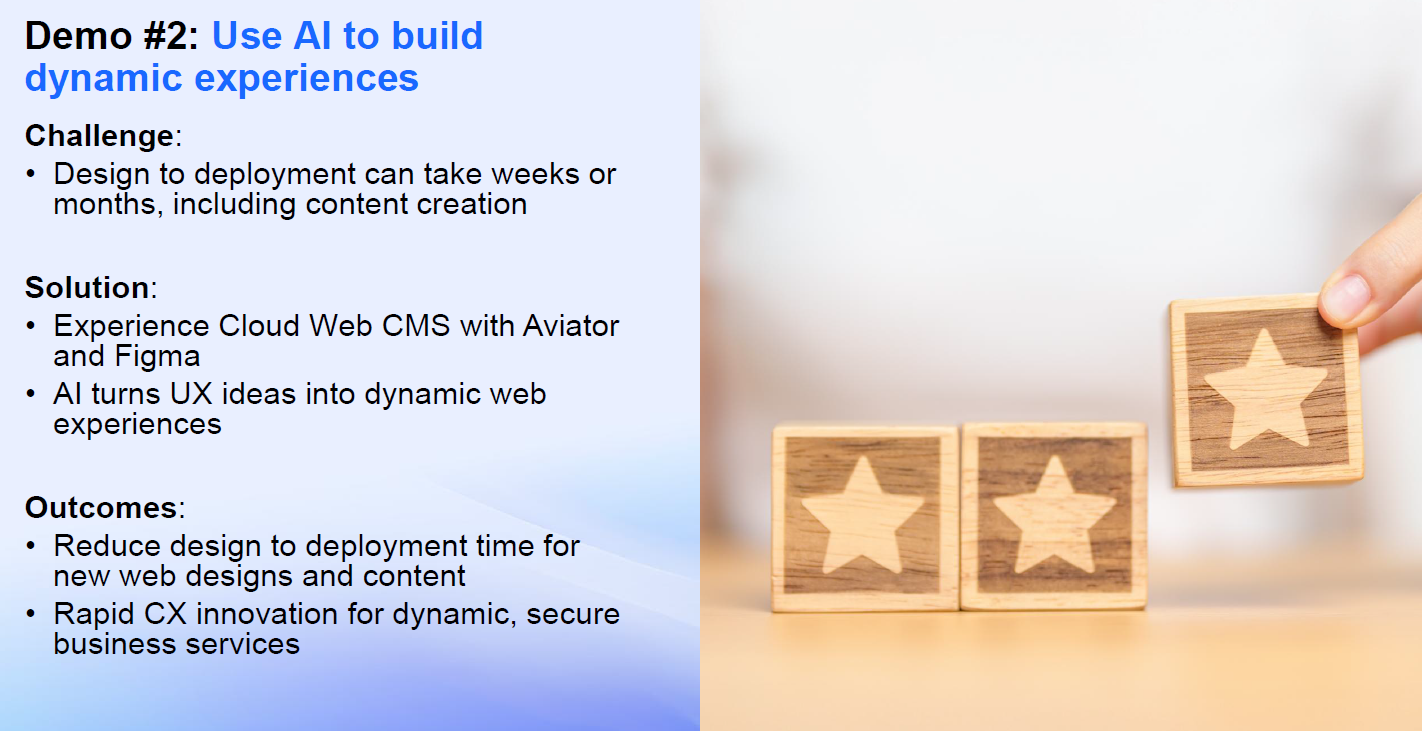
So with our Web CMS, we now have Aviator that allows you to work with your creative services, working in Figma, to design an experience, to be able to then bring that rapidly into the CMS, and actually instrument it to be able to rapidly deliver information to your customers. So let’s look at what that looks like.
So here’s Figma. Your creative services teams are likely working in Figma. They’re meeting with your business and deciding what kind of experience they want to have to deliver to the customers. This is an OpenText Experience here, and it’s got a lot of different components on it and a lot of different sections. And so what we can do—and this will be a very quick look at it, but we can export directly out of Figma. And that will bring the design fully into our Web CMS. You can see there are lots of different elements of the Experience here.
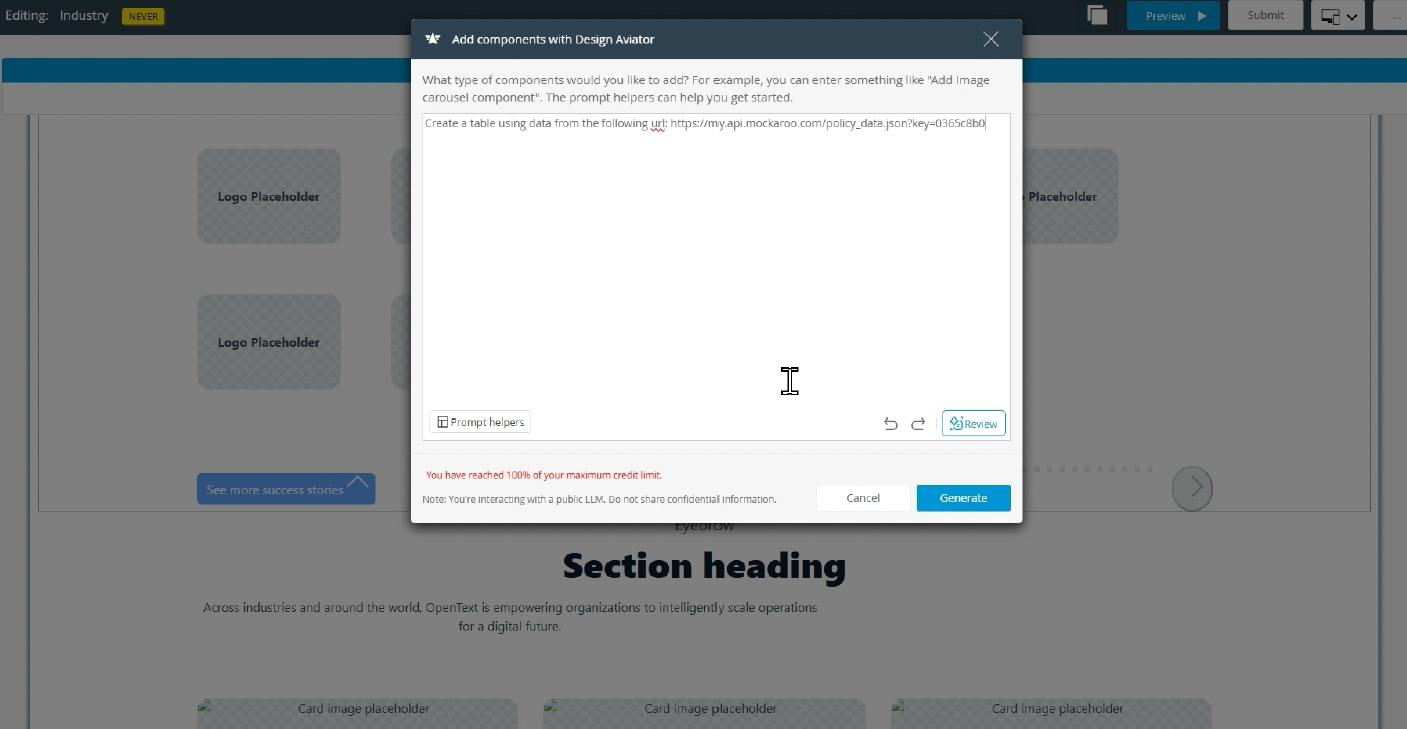
And so just I won’t show the export and then the import, but the end result is in the Web CMS. That design is ready and available to start to display and bring information out, to deliver out to your published web experiences. So here, we have that same design brought in. I’m going to pause here because now maybe I want to modify it a little bit further, just want to iterate further. So what if we want to actually, instead of having an awareness kind of an experience, we want to deliver dynamic information.
So we want to actually deliver a service through this template. So here, what we can do—you’ll see there’s a little Aviator button there. So right there, I want to add some information, dynamic information. Not coming from the CMS. It’s coming from a business service. So we can click the Aviator button. And this is going to allow us to prompt further. And in this case, the prompt is very simple. We’re going to say, create a table using data from a URL. This is a data source, so we’re going to create a component in the Experience, and we’re going to connect to a service, a data service, and display it.
And so the prompt is just going to very quickly do that. And we’re going to up our credits here, too. And so just with that simple prompt, we’re able to—the AI is able to go out, recognize a table component that we have. And we’re actually working on the code generation to create new experiences as well so we could be able to do both. And that will then load into the page, into this page.
Now, in this case, it’s all anonymized data, but it’s just connected to—it’s literally a web service that’s bringing this data. It’s all anonymized data in this case, and is presenting it in now a dynamic presentation, where as a consumer of the information, I can page through it differently. I can filter on it. The point is that it’s not CMS data. This wasn’t authored. This is a data source. And these data sources are what’s really critical. How do you take a data source? How do you take a component that you’re going to use to deliver it, to present it?
It’s very similar in the communications world, how you’re going to put information into a communication. So same sort of concept here. What we’re doing is using the AI to connect data sources with presentation to—yes, to users, but also to digital consumers of that information.
Colin Brown: So Guy, this is a pretty amazing feature that you put out here. How long would this have taken somebody in the past to build something like this?
Guy Hellier: To do all of that would have been certainly in a days, weeks type of a time scale.
Colin Brown: And we did it in seconds.
Guy Hellier: And it’s done, and the mechanics of that is now greatly reduced down to minutes.
Colin Brown: And what’s been the early feedback from some of the customers we’ve shared this with?
Guy Hellier: I want it, and—
Colin Brown: My favorite response.
Guy Hellier: We had a customer—I won’t say who it was—who said, oh, bleep. Now I have to upgrade. Now I have to upgrade again. So yes, it’s going to take a lot of time out of that process. And I think the really key thing is it’s—how do we, in a more automated way, recompose information and deliver it? Maybe not even with a template in the future, but rather an at-runtime composition of this information.
Guy Hellier: So how do we bring all of that together? So here, now what we want to do is I want to go back and we’re going to take a look at what was our insurance renewal journey. So if we flip, there we go. So if we flip—and I’m going to refresh my view. There we go. So all right, excellent numbers. 40 of you chose Robert. 23 of you chose Julie. Eight of you gave us a text that a conversation engine would have been able to handle. Hopefully you got our nice thank you for sending us that.
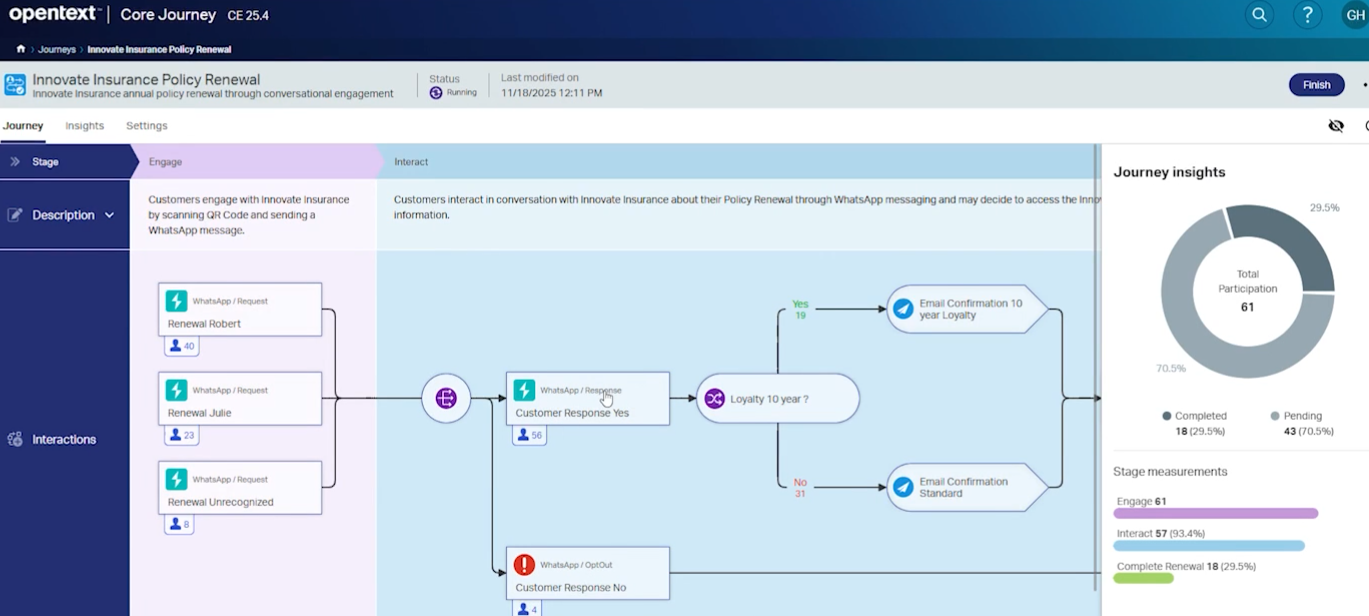
So that unrecognized text, and then as you’ve gone through, so 56 of you chose the Yes path. Thank you. Four of you said you didn’t want more. Hopefully you went back and went down the Yes path as well. So you can see then if we were then able to segment further the flow, if you were—in this case, it was Julie. So if you were a 10-year renewal, we took you down the loyalty communication path. And if you were a standard renewal, we took you down the other and we got 18.
Now this is a little tricky in our demo. We didn’t make it really clear where to finish the journey. But in sum up, so 61, 57 went through the interaction stage. We got 18 of you to completion. We need to work on our digital experience a little better. So thank you for participating in that.
But to take this a little bit further, if you think about this, this is a conversation. This is a conversation around a renewal experience. And so you want to go further and be able to segment. And Chris spoke about segmenting, being able to segment and have these conversations with—let’s flip back, please—have these conversations with groups of your customers.
So the Core Journey solution will now have the ability to engage customers on a segment basis, all as a business UI, which if you’re using our communication solution today, we don’t really make that as easy today as we could. So a new user experience for business users will allow you to have a look at what those engagements are, so you get a nice dashboard on that, but also to go open up one. Let’s say a policy renewal journey, where we’re targeting customers who are renewing for the 10th year, maybe we want to have something very special for them.
And so we’re bringing the tools together, where, in one place, I can go in and edit the communication template that I’m using here. And in this case, this is our communications author, where I have the body of that email, where I can go in and connect it right into that is digital asset management. This is our Core Digital Asset Management solution. So I can choose the right asset. I can modify it. And when you think about AI and modifying assets to fit the authoring purpose, that will all be built into the authoring experience.
And so this is the full communication authoring experience here, with all of your targeted content and your ability to personalize communications built in, which then leads to, OK, the customer data. What is the segment? So where we’re able to pre-map that data file to drive the communication for that segment. And then, of course, the journey that we just talked about, it’s built into the tool. So when you’re going to go engage, have a conversation with the customer, the journey is already built-in. The communication content, the customer data, the journey itself will be building in the digital experience as well. The analytics, so that you can see and so forth, so on and so forth down the wizard here.
And then it’s a simple process of activating this engagement, this conversation. And then as customers either fall into that segment or we proactively go out to reach them, we’re now able to dynamically watch and dynamically optimize this conversation with our customers.
So what you saw there was going from just a simple approach of how do we better engage today, how do we better engage our customers with two-way messaging, with interactive messaging, which is a simple experience on all of our devices, that’s going to create transparency and trust by building these conversations around these critical business events that you all support today. So you’re doing this today, but this can make that better.
We’re going to help you bring in rapid design innovation, and that design innovation with AI is going to lead to more rapid dynamic experience innovation, so actually generating those components that are used to deliver the services. And, of course, our approach with the Experience Cloud is to bring the tools together to more and more have user experiences and AI interfaces to be able to drive the tools all together, where it’s one prompt or one interface to get a task done. And so doing that in our unified Experience Cloud, we’re doing this now and we’re so excited about what’s coming in the year ahead.
Colin Brown: And then real quick, Guy. How do you see this in 26.2 and 26.4 with the AI data cloud and knowledge graphs throughout the product?
So we’re going to get to that in the roadmap, but yes, so you’ll see that in 26.2 and in 26.4. So we’ll get to that in the roadmap, but big theme talking with people here has been the ability to choose the right model. That’s big. That’s going to be big for us in 26.2. And again, by the way, our nomenclature, “26 dot,” that release number is the year-dot-quarter. So second quarter of 2026, and then fourth quarter of 2026. And then the fourth quarter is when the Data Cloud and the Aviator Studio will come in. So we’ll cover that in roadmap in just a second.
So I’d now like to bring up Janet again, who’s going to introduce our next customer.
Fireside Chat with The Standard: From transactions to conversations in Insurance
Janet de Guzman: Thank you very much, you guys. It is my distinct pleasure to introduce our special guest, our second special guest today, Kate Feindell, who is the director of Enterprise Content Management Platforms at The Standard. Kate, come on up. Get comfortable here. OK. Kate, please tell everybody here—I’ve really had the pleasure of getting to you as—I’ve seen you at OpenText Worlds, many, and then also just as we were preparing for today. But do tell the folks here a little bit about yourself and what you do at The Standard.
OpenText digital experience: The StandardKate Feindell (Director of Enterprise Content Management Platforms, The Standard): Hello. I have worked at The Standard for 28 years, and currently my role is director of enterprise content management platforms, which is a slew of content management and content generation platforms. Our job is to make sure that the business has innovative solutions that help them bring customer value. The Standard was founded in 1906. We serve both businesses and individuals with workplace benefits and financial services. One of the things that sets The Standard apart is our involvement in the community. We hold an annual volunteer expo to put volunteer organizations and volunteers together, and our Employee Giving Campaign raised $7.2 million last year. So it’s great.
Janet de Guzman: That’s amazing. So just great corporate citizenship as well.
Kate Feindell: Yes.
Janet de Guzman: So, Kate, we’re talking about communications. And in the insurance industry, trust is so paramount, especially as your customers are dealing with life events. But interacting with an insurance company, if we all think about our own, it’s not very often. They’re so few and far between, those experiences with interactions. So how does your team ensure that every experience is a trustworthy one and something that leaves them feeling that they’re important?
Kate Feindell: Well, one of the things about The Standard is we don’t just sell products. We sell a promise. Our promise is to help you move forward every day. So one of the ways that my team helps that is ensuring our systems are available, that we’re building systems and solutions that actually add value and help that customer know, hey, how is my claim doing? Where is it at in the process? Am I going to get paid like I’m expecting to? Are you there? Are you supporting your promise that you made to me?
Janet de Guzman: Associated with that, you’ve heard us talk about conversations as a new customer experience. So meaning that these interactions should be continuous. They should be interactive, not transactional or one-way. How are you seeing that shift play out in your industry?
Kate Feindell: One of the things that has happened recently is building customer portals. These customer portals allow the customer to actively go out and say, hey, where’s my claim? I misplaced that claim letter. Where is it? Oh, I can go to my portal. I can pull that up. Oh, great. This is what they said about my claim. This is where I’m at. It also may—I don’t know if it’s true today, but it will be soon, to have a customer 360 so that they can actually engage with us through SMS or text messages or emails so that we’re there for them when they need us.
Janet de Guzman: I love that. And it’s so much more important when, again, in the insurance industry, where you are highly regulated as well, that these communications are also compliant and governed. So how do you ensure that your communications—oh, good, the fire’s up. Oh, I’m finally warm.
Kate Feindell: Yes.
Janet de Guzman: How do you like that? I was going to ask, why didn’t we get a fire when Chris got a fire? How do you ensure that your communications with your customers remain compliant and on-brand across so many product lines that you have, different regions. That must be a tough balance.
Kate Feindell: Yes. A couple tools really help us. One is having a brand library so that you can have all your corporate-approved logos, themes, colors, style sheets available for your content authors and your developers, available at their fingertips. The other way is using tools like OpenText Communications. We know that our results there will be pixel-perfect, and they’re going to be the regulatory filed copy that is distributed.
Janet de Guzman: And how does that make you feel, to—
Kate Feindell: It makes me feel good that I know I’m delivering the right thing to my customer. I know that we’re not going to get in trouble for sending out the wrong information, that it is exactly what the customer needs to see.
Janet de Guzman: Yes. So just stability, that operational stability we talked about. We’ve had great operational stability on our OpenText Communications platform—in the cloud, might I add. I did not—I’m not paying her to say that.
Kate Feindell: No, she’s not, but things have been great.
Janet de Guzman: That was a bonus question I gave you there. So I do like asking in the fireside chats about the stakeholders. And so like many initiatives, customer communication management is at a crossroads between the business and IT, business and technology. That’s no different, I’m sure, at The Standard. So how is that relationship with the two stakeholders, as you both want to deliver the best customer experiences, and has AI and its rapid rise changed any of that?
Kate Feindell: Of course, it has. Customers want real-time communication. And our business users and customers, frankly, have a lot of AI, low code, no code tools at their hands. So we have to work together. The business knows the customer, our market. The IT knows the technology. Together, we have to solution, talking to our stakeholders, what would you really want? What do you need in a solution so that we can design what fits and is at their fingertips?
Janet de Guzman: I love that. And do you have any advice for anyone that is starting on this journey of modernizing customer communications or CX with your decades of experience, whether it be around stakeholder management or just anything at all?
Kate Feindell: So a few things that I think come to mind is keeping your customer in the forefront and not necessarily the technology. The technology enables us to move forward. And listening to your stakeholders, listening to your customers. Make sure that you’re hearing them and not just sitting there nodding. You’re actually hearing them. Repeat back what you heard. Think about, hey, if I was the customer, what do I need to make sure that I feel like my business is being served here, my needs are being met. And that really helps put you in the driver’s seat.
Janet de Guzman: I think that’s great. And how many of your colleagues are here at OpenText?
Kate Feindell: Well, that full front table right there.
Janet de Guzman: Oh, right here? Is it, like, 10?
Kate Feindell: I think there’s between 8 and 10 here.
Janet de Guzman: Welcome, everyone. And Kate, thank you again so much for being such a great partner to OpenText all these years and for being part of our fireside chat. Really enjoyed partnering with you, and I enjoyed this.
Kate Feindell: Thank you, Janet.
Janet de Guzman: All right. Thanks.
Our journey ahead: The Experience Cloud roadmap
Janet de Guzman: The fun part, the roadmap. The way ahead.
Guy Hellier: And so, first of all, a thank you because we don’t have a roadmap without you guys. We don’t have a roadmap without your business challenges, without your effort, without your investment in partnering with us. So I just, in this event—I think that wasn’t scripted, but it’s so important. So the road ahead is filled with a lot more than what’s on the slide. But what we want you to be aware of is that, again, we release in year-dot-quarter, and we look at our investments around just very, very broad innovation that’s going to make a difference in your organizations, in your outcomes.
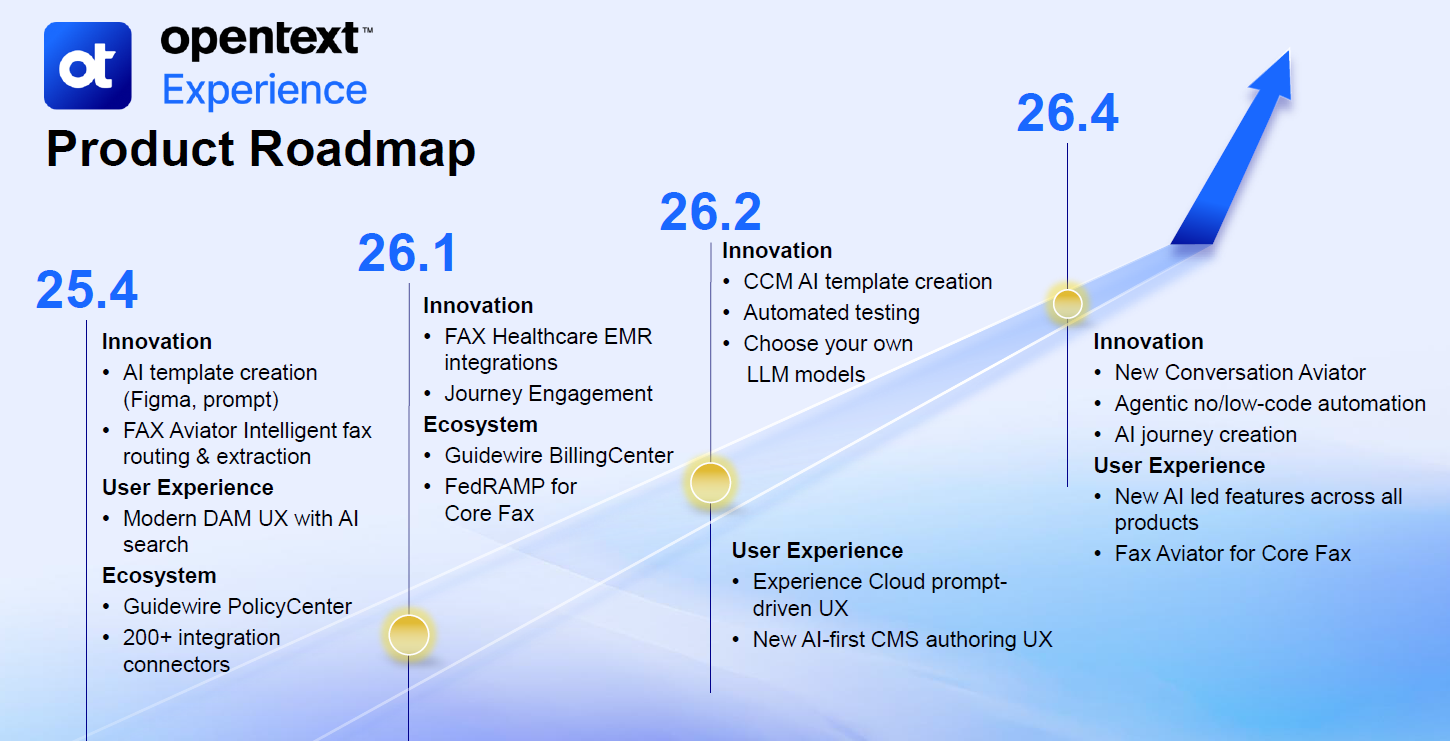
And the feature innovation, so there’s going to be a lot of that, very AI-centric, and we showed some of that today for 25.4. But we’re also investing a lot in user experience. And the UX work that we will be doing is also AI-centric. Showed some examples here, today. So if you come to our follow-on sessions, and in particular, we’re going to cover this more in a couple of our follow-on sessions what we’re doing in user experience. And then ecosystem, integrating to the ecosystem. We can’t put the data together, the information together, the right way without connecting the ecosystem together.
So we not only integrate to some of these business systems, like, of course, SAP and Salesforce and Guidewire, but we’re actually also integrating through integration platform as a service. We’re partnering to be able to bring that to you. A partner is here for that, so we’re very excited about that, the ability to much more rapidly integrate our solutions together. But 26.2—so to your question earlier, Colin, 26.2 will be bringing model services, where we’re going to be able to expand choices of LLMs to use in the Experience Aviators. And then in 26.4 is where we see that conversation Aviator—
Colin Brown: Did you just say our customers will be able to use their own LLMs in 26.2?
Guy Hellier: That is—yes. That is the plan, and that is where we’re going. And so that is—and we hear that asked repeatedly. It was a huge discussion yesterday about how to do that. And I think there’s this big, fine balance. There’s a big balance between what we’re bringing in the product that just works as it is, and then your needs to use your models. We hear it loud and clear. And so that’s really key for 26.2 and for 26.4. And you’ll hear more in 26.2 about this.
Guy Hellier: So as I said, we have product management leaders here with us. So up next is communications, the breakout up next. And so Randy Sparks will be leading that. You’ll hear from Sri Raghavan and myself as well in the Web CMS and DAM session. And then Stephanie Pieruccini and myself tomorrow morning about Journey. So that’s the way forward.
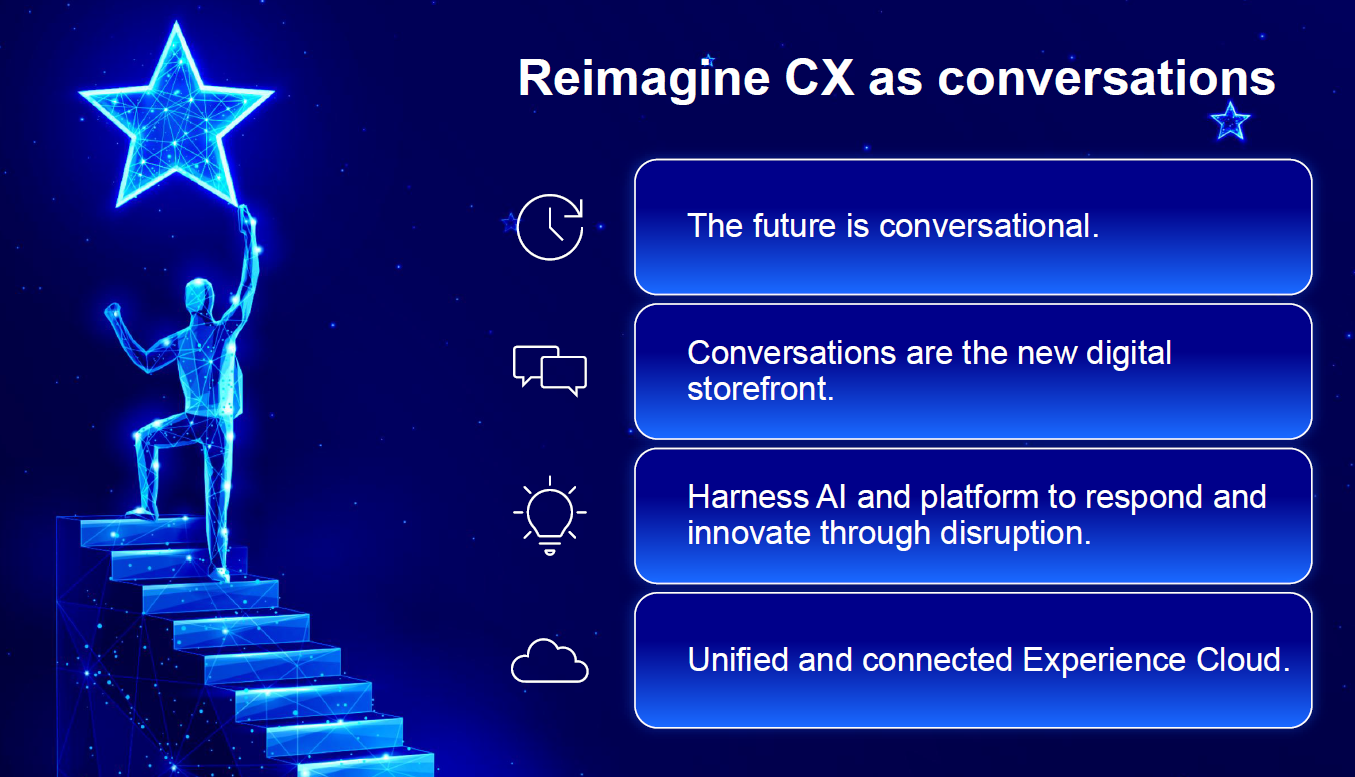
Colin Brown: That’s great. So real quick, thank you all for coming today. We’re going to hand it off to Janet in a second to tell you what to do next at OT World, but we want to remind you, the future is conversational. I think we had a great conversation today. Harness AI, use the platform to respond and innovate through this disruption period, and we’ll help you with the Experience Cloud. And thank you all. Janet, take us to where to go next.
Janet de Guzman: OK. Great. Thank you both. Thank you so much. All right, guys. Yes. Great roadmap. All right, folks, so before you go, we got s’mores. So be sure to go to the expo, if you haven’t already, and visit the digital experience booth. Talk to an expert. Ask them to see some of the great things that you saw today that Guy showed you. And ask them, how do I get started? How do I get started on my modernization journey, whether it’s OpenText Communications or Web CMS or DAM or otherwise. So how do we get to the full platform?
And also we have s’mores. I mentioned that already. There will be a mini fire there, I’m told. And again, if you haven’t been yet, 9,000 square feet dedicated to the Aviator Playground. That is incredible. So it’s over 30 workstations where you can get hands to keyboard to play with, prompt, test, try out a bunch of OpenText Aviators, including the Design Aviator that Guy demonstrated today. So please go and have a look at that. It is really exciting.
Within the playground is also the industry booths. So you can talk to an expert there in the vertical in which you work. So it’s the first time we’ve done it and we’re really super excited about it. So make sure you spend some time there. We just are finishing the keynote now. We really love that it precedes all of the other sessions for experience. If you haven’t downloaded the app yet, please do. If you have, filter for “Experience,” and then you’ll find all of the sessions.
The next one is happening in about 10 minutes and it’s happening, as Guy said, in Room 208B, with a focus of OpenText Communications. And then the one right after that, in the same room, has a focus on OpenText Web CMS and DAM; both sessions—and all our sessions, of course—put it in the context of the bigger story of OpenText Experience Cloud.
And some of you have been invited, and hopefully those who have will be joining us at this by invitation only. It’s an AI roundtable. If you haven’t, then talk to your account executive if they’re here, or talk to me, and we’d love to have you. We do have a maximum of 15 seats, though, but we do have a couple of seats left. We’re going to be talking about AI, and you’ll have an opportunity to hear Kaspar Roos, who is the CEO and founder of Aspire, to share a little bit about AI trends in customer experience, and then you’ll hear from each other on where everybody is in their journeys and what concerns them about AI and excites them.
Tomorrow morning—or tomorrow at 1 o’clock, there is another breakout for our journey orchestration technology. So this is super exciting. Journey is having its moment. It is the star of the show. It is the glue. It is what ties everything together. And that says “2:15.” It should be 1 o’clock. Sorry. That’s 1 o’clock. And then in the expo, there is a couple of theaters, and those dark blue sessions are the ones that are going to be in the expo theaters.
And then finally, at the end of the day tomorrow, our last session, “Beyond ERP—How SAP and OpenText Transform Customer Experience.” If you are an SAP shop and you care about customer experience, then you must attend that. In your app, you’re able to, if you haven’t noticed already, download a bunch of exciting assets, not only from our business unit, but others as well. These are just three of them that are available for us and for you, in Experience Cloud, complimentary for our guests at OpenText World.
And so with that, I’d like to, on behalf of Guy and Colin, thank you so much for joining us at our keynote this afternoon, and we hope that you have an incredible week in Nashville at OpenText World, and you learn a ton and meet some new friends along the way. Thank you.
Related Content:
- The future of customer experience: top 5 insights from OpenText World 2025
- Take your customer communications from generic to genius
- Introducing Core Journey with Engagements — the next step in unified customer experience orchestration.
- One experience platform. One price. Unlimited possibilities.
- Elevate customer experiences with OpenText Aviator
- OpenText named a leader in the 2025 Aspire CXP and AnyPrem CCM Leaderboard market segments
- If your customer experience still runs on legacy stacks, you’re already behind