
OpenText™ Web CMS is a web content management platform built to support complex, large-scale digital experiences. It helps teams create, manage, and publish content efficiently while maintaining control over structure, compliance, and brand consistency.
As content demands grow across channels and regions, the platform continues to evolve with regular enhancements to usability, flexibility, and performance. This rolling blog captures what’s new in each release—so you can quickly understand what’s changed and how it supports your day-to-day work.
May 2026: What’s New in Web CMS CE 26.2
As web content operations scale, the demands on CMS administrators and content teams have grown well beyond publishing. Managing what lives on a site is now just as critical as getting it there in the first place, and teams need more precision and control at every stage of the content lifecycle.
The 26.2 release addresses two persistent operational pain points: the complexity of removing content from live environments, and the friction of managing system upgrades.
Unpublish workflow
Content teams have long faced an all-or-nothing problem when removing content from live sites. With 26.2, Web CMS introduces a dedicated unpublish workflow that lets teams remove content from the published environment without deleting it from the authoring environment.
- Protect content integrity by preserving metadata, relationships, and version history even after content is taken offline.
- Improve governance and operational flexibility with granular control over what lives in the published environment versus what is retained in authoring.
- Reduce the risk of accidental data loss by decoupling unpublishing from permanent deletion.
Upgrade configuration utilities
System upgrades have historically been among the most time-consuming parts of CMS administration, with configuration file management causing unnecessary delays and support overhead. New tooling in 26.2 helps administrators identify, analyze, and merge configuration changes more efficiently during the upgrade process.
- Save administrator time and reduce frustration with tools purpose-built to simplify the most complex part of an upgrade.
- Minimize support interactions by empowering teams to confidently and independently handle configuration changes.
- Accelerate time-to-value for new releases by removing the guesswork from upgrade readiness.
December 2025: OpenText Web CMS CE 25.4
Today’s marketing teams are operating under a new set of expectations. The pressure to ship web experiences faster, without sacrificing brand fidelity or content quality, has made the gap between design and delivery one of the most costly friction points in the enterprise. At the same time, generative AI has moved from experimental to essential: marketers and content teams are no longer asking if AI belongs in their CMS workflow, but how quickly they can put it to work. For Web CMS platforms, the mandate is clear. Reduce handoff overhead, accelerate page production, and make intelligent content creation accessible to the people who need it most.
OpenText Web CMS 25.4 delivers on both fronts.
Figma design upload
Design-to-web handoffs have long been a source of delay, rework, and brand drift. With 25.4, marketing and digital teams can now upload Figma designs directly into OpenText Web CMS, converting approved creative assets into functional web pages and brand templates without coding.
- Compress the design-to-publish cycle by eliminating the translation layer between design and development, getting experiences live faster.
- Preserve brand standards at the source by using approved Figma assets as foundational templates rather than recreating them manually in the CMS.
- Empower non-technical users to build and maintain brand-consistent pages without relying on developer resources.
GenAI-powered experience creation
Marketers now have access to AI-assisted page creation powered by Design Aviator, embedded directly in the CMS authoring experience. Teams can generate functional pages, templates, forms, and visual layouts from a prompt, an uploaded image, or an imported Figma file.
- Build rich web experiences in minutes, not days, without manual development effort or specialized technical skills.
- Scale content production across campaigns, microsites, and landing pages by generating on-brand experiences from a single starting point.
- Reduce dependency on IT and agency resources by putting experience creation directly in the hands of the marketers driving it.
Introducing OpenText Web CMS
OpenText™ Experience Cloud Edition 24.2 was a big milestone for our web content management system with the release of OpenText™ Web CMS. The evolved and expanded product is the next generation of the previous flagship OpenText TeamSite. TeamSite had greatly changed over 25 years and was a pioneer and innovator in the industry. To better reflect market changes and new technologies, OpenText Web CMS marks a new era with expanded use cases and capabilities.
Beyond traditional content management
OpenText Web CMS transcends traditional content management by delivering:
- AI-powered experiences that dynamically adapt to user needs
- Interactive experience applications including HTML5 calculators, wizards, and data visualizations
- Customer journey mapping with robust data foundations
- Flexible deployment options with enhanced hybrid and headless capabilities
- Embedded Digital Asset Management (DAM) for seamless media integration
- Extensive integration platform supporting diverse business systems
Focusing on customer success
The most significant shift? Using web experiences to drive the complete customer lifecycle—from purchase through onboarding to retention and loyalty. While many companies focus primarily on acquisition, research shows existing customers are 50% more likely to try new products and spend 31% more than new customers. OpenText Web CMS excels at nurturing these valuable relationships.
April 2025: Power-packed 25.2 release – Titanium X
The Experience Cloud’s 25.2 release delivers Titanium X, helping organizations win in today’s experience economy. This release builds on innovations from CE 23.1 through CE 25.2, empowering companies to modernize their customer experience platforms. Users crave interactive experiences. Adding just one video increases average time-on-page by 88%. All industries are witnessing rapid adoption of progressive web applications (PWAs), single page applications (SPAs), and dynamic experiences built with modern frameworks like HTML5, React, and Angular.
Bridging developer-business silos
Success today requires bridging silos between developers, business users, and creative teams. OpenText Web CMS delivers this through:
- Developer flexibility: Use any language (React, Angular) beyond traditional SPAs
- Component collaboration: Multiple components working together with CI/CD pipeline management
- Connected data sources: External data integration through component properties
- Business user empowerment: No-code/low-code editing for non-technical teams
- Inter-component communication: Creating cohesive experiences across components
New 25.2 capabilities
The latest release introduces:
- Flexible Component Layout framework with table component integration
- XML file format support for both data sources and business user modifications
- Streamlined development with improved team collaboration
- Enhanced consistency and workflow efficiency
Look back and look forward
The release builds on years of innovation across five key areas:
- Dynamic experiences and experience application management
- AI capabilities including GenAI and intelligent content tools
- Integrated customer journeys and customer data
- Modernizing on a cloud platform with Kubernetes for scale, performance and high availability
Stay tuned for more innovations as we continue helping businesses thrive in the experience economy.
November 2023: What’s new in TeamSite 23.4
The rise of app-like web experiences
Part of the answer is interactive content – applications and videos. By including a video, the average time on page goes up by 88%. All industries are seeing a dramatic rise in the use of progressive web applications (PWAs), single page applications (SPAs), and dynamic web experience development using modern IDEs like HTML 5, React, WebAssembly, Angular and many others. Businesses can’t thrive with just content management in a CMS or WCM system today, their future needs to bridge the new silos between developers, business users and creative teams to succeed. The rise of headless is just one example of the trend, however it doesn’t need to be a developer centric versus business user only workspace. Hybrid headless collaboration serves both and is always a win-win scenario. Let’s see how OpenTextTM TeamSite delivers on the promise.
Introducing OpenText TeamSite 23.4
The 23.4 release delivers a new framework expanding our unique hybrid headless approach designed to help bridge the gap between the developer and business user personas. These features reduce the friction of the development cycle, managing and deploying dynamic application experiences using modern languages and IDE tools while empowering the business with flexible design and creative tools.
- Marketers can now edit or change variables directly on the glass, enabling rich dynamic experiences. This brings design flexibility and creativity back into the hands of the business owner, while reducing the need for follow-on development work.
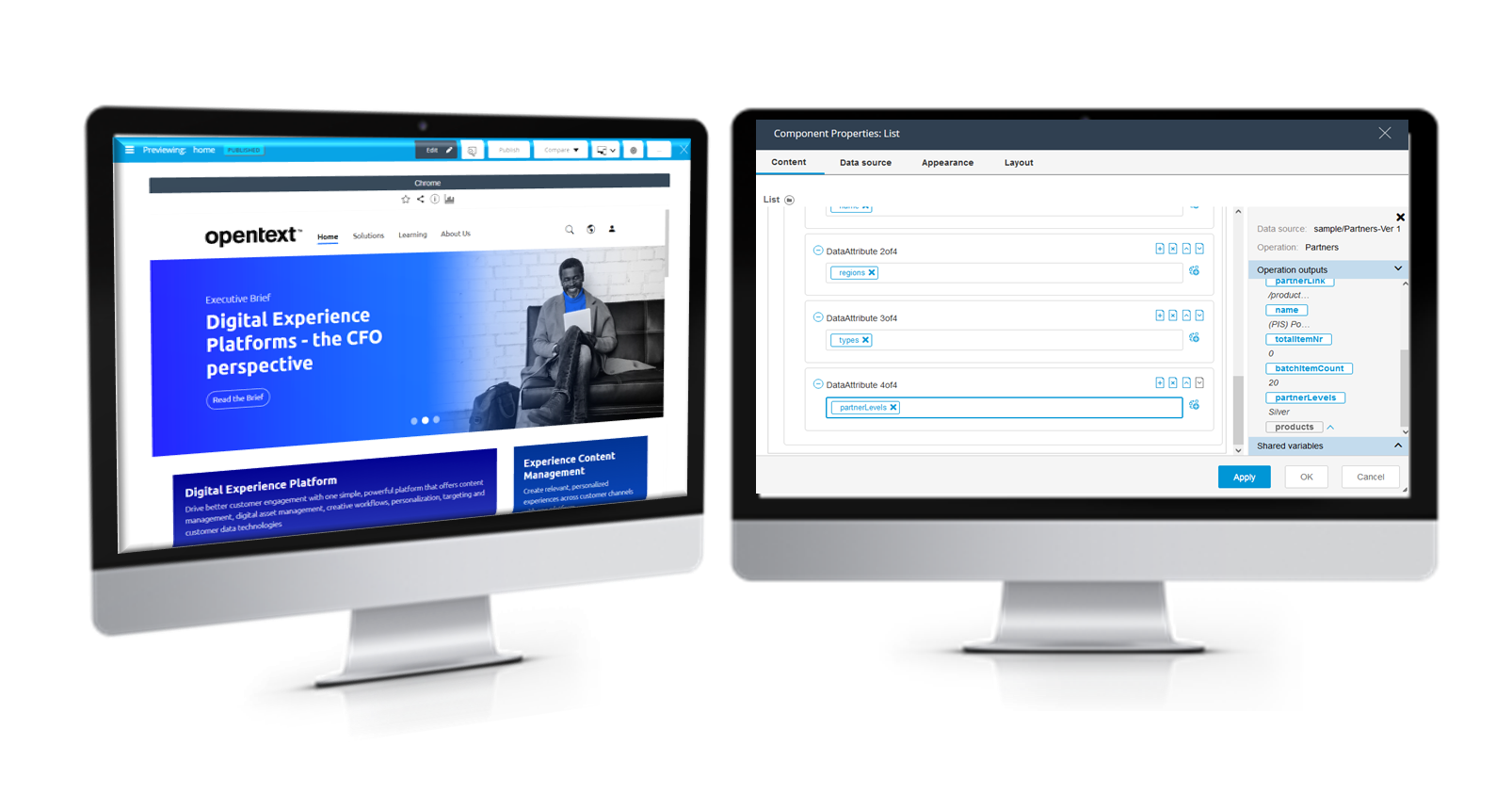
- Composable experiences are easier to create, use and modify. Low-code components can be connected to data sources where business users can directly leverage their content. They can be defined with event-driven actions to establish communications and initiate changes between components to build endless dynamic possibilities. Components are built around functionality, then easily repurposed and connected to a different data source to satisfy a completely new use case, saving valuable developer cycles.
- Manage and govern the entire process of development to deployment, including your live Web performance, including options for hybrid headless, high availability and Content Delivery Network (CDN).
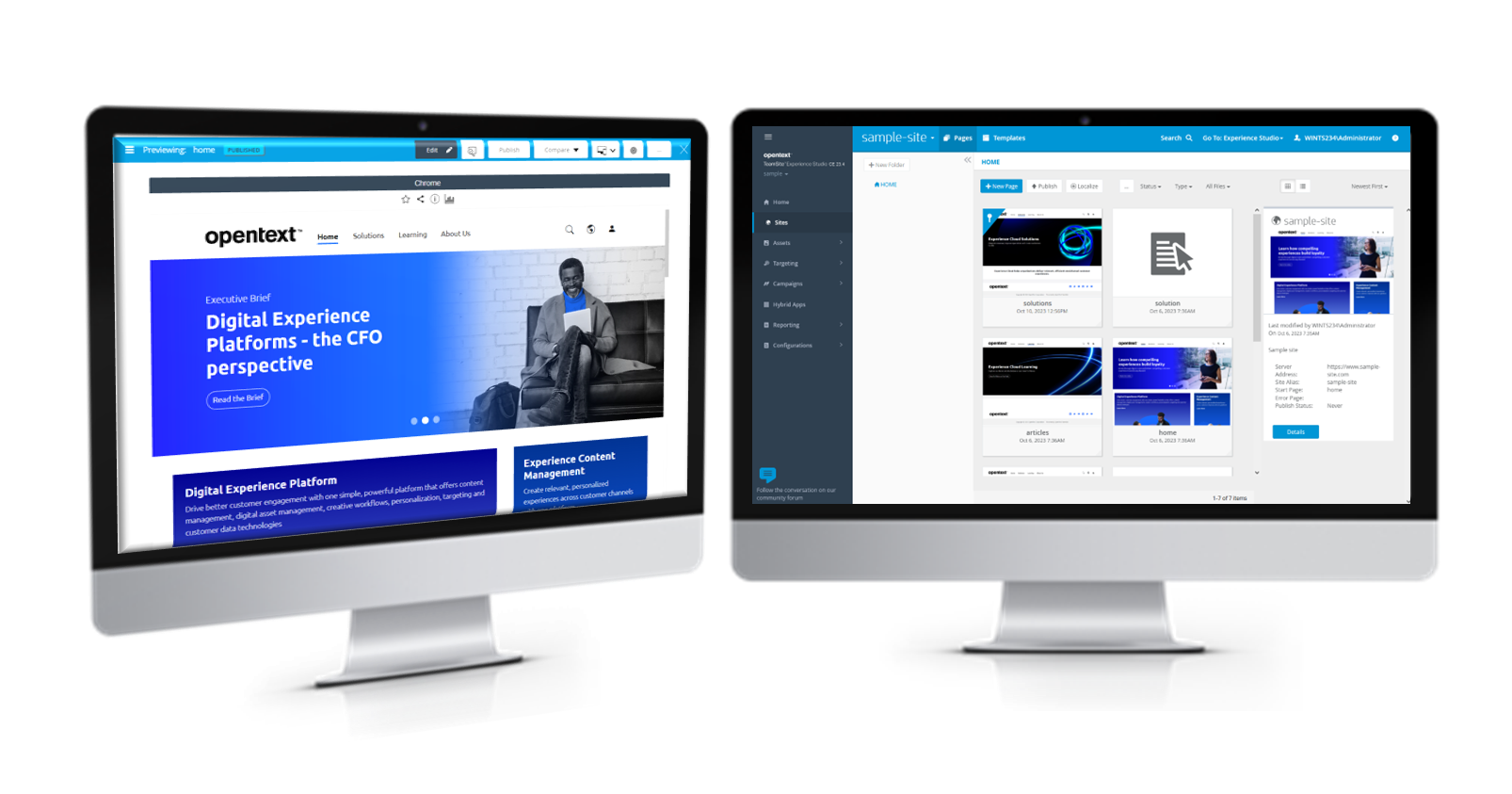
- Built-in governance of applications and development projects. Teams work together with the right privileges and libraries of components are available for drag-and-drop use or modification. Know where the components are used, version-control them, or create new ones.
- Sample Web experiences are provided in this release for teams to demo, test and use various features out of the box (OOTB). The experiences contain: modern page and template layouts, forms, localization, working search, targeting and much, much more. Check out the new site for a fantastic hands-on experience.
What else in 23.4?
As part of the OpenText Experience Cloud, TeamSite works seamlessly with other key experience technologies: customer communications, digital asset management, personalization, customer data, A/B testing, notifications, and voice analytics. Read more about the Experience Cloud 23.4 release, including powerful new AI, Experience Aviator, enhancements in unified UX, and other foundational services.
May 2023: What’s new in TeamSite 23.2
OpenText™ TeamSite™ 23.2 makes it super simple for developers and marketing to work together on creating highly personalized and interactive experiences. The new TeamSite release extends current developer frameworks to be agnostic and integrate with your choice of IDE (Independent Development Environment) to create, edit and deploy interactive applications using languages and tools such as React, Angular and other JavaScript apps and front-end user experiences. These experiences could extend to interactive online calculators, forms, UX experiences like sliders or accordions, embedded video and many more, literally anything developers and marketing can dream-up and innovate with.
Savvy marketers know that providing a great content experience helps boost customer engagement and conversion rates. Research shows 93% of marketers believe that interactive content is more effective at educating the buyer compared to static content. It also generates four to five times more page views and two times more conversions.
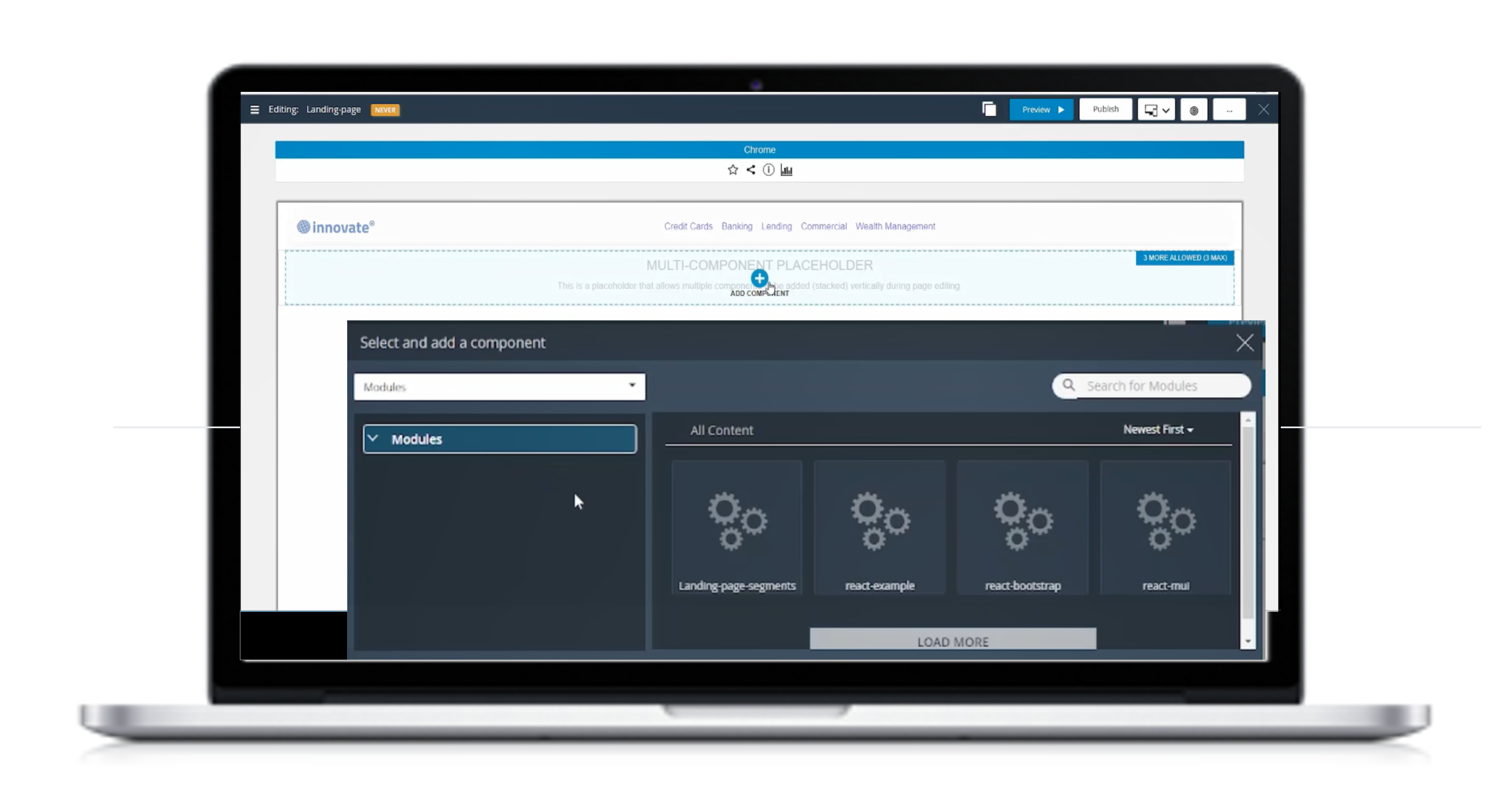
Powerful interactive experiences are unleashed with this release, making this content type easily available to business users to drag, drop, edit available properties, and preview all in-context of the page and the specific component. And we are not stopping there, new frameworks and tools for DevOps and CI/CD are also available for implementation, encouraging reuse of development efforts. Take a holistic approach to how these compelling interactive experiences are managed and deployed.
Extending to more data sources plus generative AI
For 23.2, TeamSite also tapped into the power of combining marketing, data analysis and development. The TeamSite CMS platform can now be extended to more data sources for A/B testing, rich media management for videos, and utilizing Generative AI for Assisted Authoring.
Using a composability approach, the new release reinforces TeamSite as a single CMS platform to be used for websites, portals and a number of other omnichannel digital experiences. The CMS platform utilizes a component, template and hybrid headless architecture that can meet a variety of business and IT needs for flexibility, performance and security.
As part of the OpenText Experience Cloud, TeamSite works seamlessly with other key experience technologies: customer communications, digital asset management, personalization, customer data, A/B testing, notifications, and voice analytics. Read more about the 23.2 Experience Cloud release, the new unified UX, and foundational services, and how they are both extended and powered by TeamSite.