
We’re in the middle of a Digital Revolution. Like previous industrial revolutions, similar forces are having significant impact. From innovations in mechanization in the early 18th century to mass production in the late 19th century and ensuing developments in computing, two forces are causing massive change, and they are extreme automation and extreme connectivity.
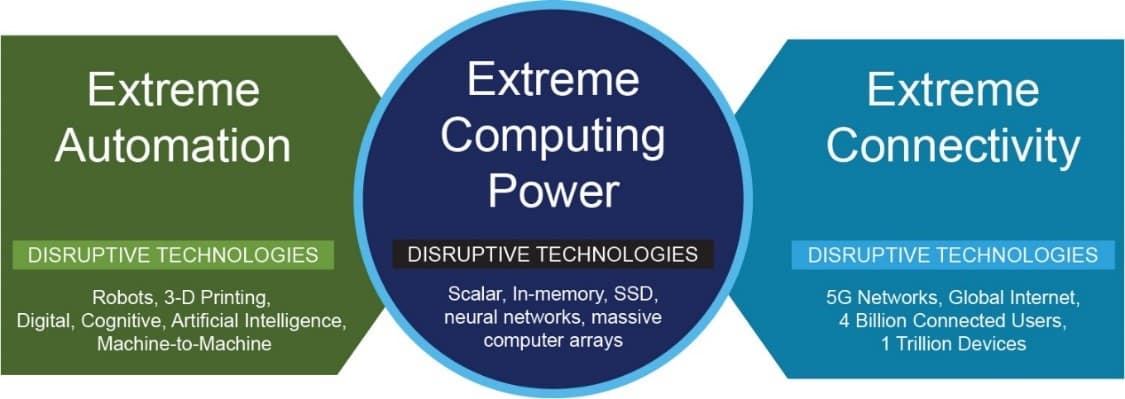
Extreme Automation and Extreme Connectivity
Extreme automation describes an increasing reliance on robotics and Artificial Intelligence (AI) in all aspects of our lives. It includes disruptive technologies like three-dimensional (3-D) printing, the Internet of Things (IoT), machine-to-machine communications (like sensors), and cognitive systems.
Extreme connectivity happens when all of these systems interact and communicate with each other and people in real time. It is 4 billion users connecting with 1 trillion devices across fifth generation (5G) wireless networks.
When extreme automation is combined with extreme connectivity, the power of our computing systems increases exponentially. The global Internet is being fueled by advances in connectivity and capacity. These advances aren’t happening in baby steps; they are 1,000-fold gains in capacity, connections for trillions of devices, and from a user perspective, incredibly low latency and rapid response rates. As more people connect with more machines, we are moving closer to zero-distance connectivity with technology.
The impact of these forces—extreme automation and extreme connectivity—will be profound.
As new economic systems and new business models emerge, a wide range of businesses that act as intermediaries will become obsolete. Automation and AI will replace many low-skill jobs and even some middle-skill, routine jobs, offsetting human capital costs. Entirely new jobs, companies, and sectors will be born. Only the organizations that embrace digitization with the flexibility to innovate will be able to overcome barriers to business to reinvent themselves, their workforce, and their markets.
The Digital Revolution will destroy jobs.
In my next post, we’ll explore the impact of the Digital Revolution.
Download The Future of Information – OpenText Release 16 white paper to discover how OpenText can help you navigate the Digital Revolution.