The Anticipant Organization

Imagine if the world went dark and there were no internet. Even for a day. For a week. Consider the massive fallout for organizations everywhere.
Digitalization has morphed from a useful function to a bedrock of society. It is at the center of all future growth. But as our technology advances beyond human limits, carrying us into an amazing future, it also introduces a new kind of crisis—the nanocrisis, a disaster whose speed and scale precludes immediate mitigation by humans. The organizations that will thrive in the digital future are those that prepare today for the disruptions to come.
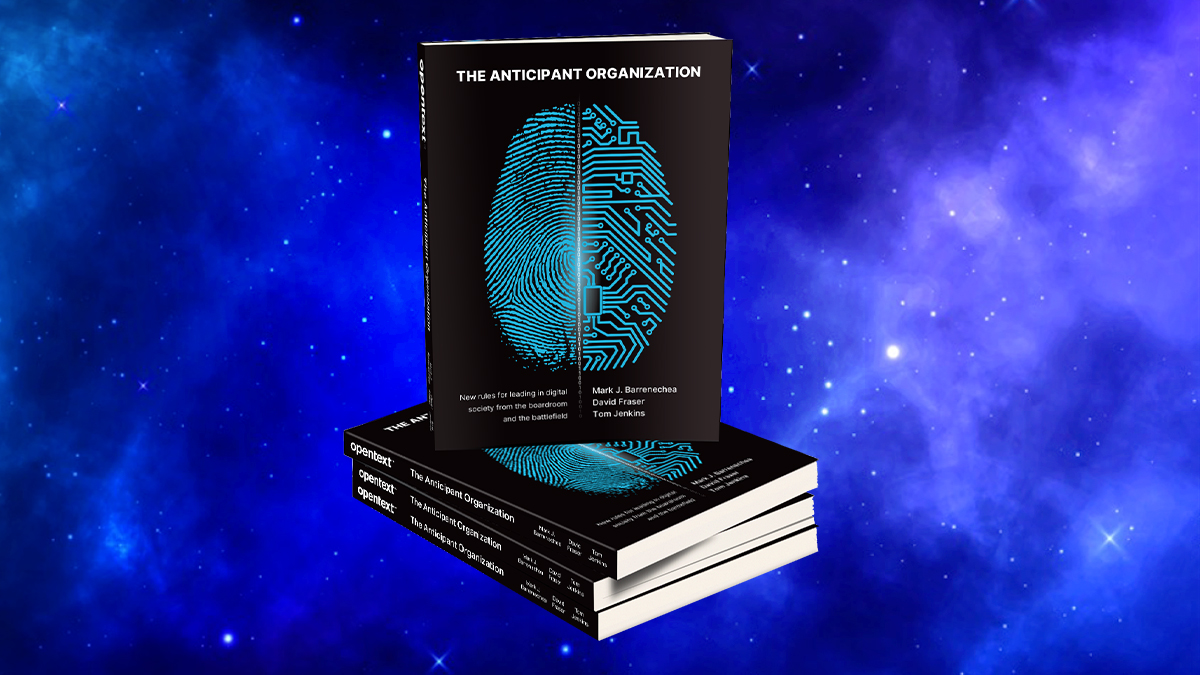
In this spirit, I am announcing our new book, The Anticipant Organization, a survival guide on how to prepare your organization for a digital crisis and adapt to the new world of human-machine teams. I am honored to have co-authored the book with Major-General (Ret.) David Fraser, one of the most decorated generals in Canadian Armed Forces history, and Tom Jenkins, Chair of OpenText’s board and Officer of the Order of Canada. The book includes a preface with unique insights from Sir Tim Berners-Lee, inventor of the World Wide Web.
Today, information is shared not in seconds, not even in milliseconds, but in nanoseconds. Computing power doubles every 18 months. Built on previously unseen speed, automation is escalating. Network growth, across humans and the Internet of Things, is exponential.
In such a world, organizations are vulnerable on multiple fronts. Catastrophic cyberattacks and digital infiltration. Competitors using AI to make your business obsolete before you even realize the game has changed. Equipment failure, causing collapse of operations. And global instabilities, such as the War in Ukraine and rising climate change, are intensifying these risks.
In the age of the always-on, interconnected digital world, preparing for the unexpected must be every leader’s highest priority.

To take advantage of the massive opportunities offered by digitalization, while surviving the coming nanocrises, organizations must become anticipant. They must identify potential threats, craft effective responses and rehearse them in advance. They must anticipate where plans could go wrong, prepare for contingencies and be ready to adapt on the fly. As we write in the book:
There was a time when leaders consumed information by reports and presentations; now they livestream events even as they unfold. Sage advice was given by trusted advisors; leaders today rely on artificial intelligence for suprahuman insight. The analog organizations of old were hierarchical; now they must flatten to survive a crisis. But most importantly for leaders: Once their organizations were active participants in their fields; today they must also be visionary anticipants. And those who cannot anticipate will wither and die.
In a nanocrisis, sticking to the org chart is the kiss of death. So anticipant organizations are elastic. They have a dynamic chain of command that can collapse when needed to promote the fast flow of information. In the military, when the colonel can talk directly to a sniper with a target steady in their sights, the org chart can be only two levels deep. During the crisis, the leader has access to all the information and all the people, all the time. That’s a three-part advantage.
Anticipants also unite human and artificial intelligence to discover new ways to innovate. It’s about tin and tissue working together—efficiently, creatively, ethically. Such organizations embrace technological adaptation, and they experiment at scale. Iterate, rather than perfect.
Elastic, collapsible, adaptive, with rapid access to vital information. These are the hallmarks of the anticipant organization.
At OpenText, we understand anticipant strategies deeply, because we leveraged them across the past three years to respond to the global polycrisis that all organizations faced—health, geopolitical, social, climate and economic. Empowering our employees, in conjunction with our best technologies, allowed us to adapt rapidly to find innovative solutions, embrace a new equilibrium and thrive. I am excited to share some of our learnings in The Anticipant Organization, alongside deep insights from Dave and Tom, grounded in their own vast experience in military strategy and business leadership.
I am also pleased to announce that, to celebrate publication of the book, OpenText is donating $20,000 to the Canadian Forces College Foundation and Ontario Global 100. Our goal is to help grow Canada’s next generation of global, anticipant leaders.
Companies who follow the strategies for becoming anticipant will know how to act when the nanocrisis hits. While their competitors falter, anticipants will not only survive. They will seize opportunities and secure the potential for staggering new growth.
Leadership is a choice. It is time to choose.
Get ready.
To learn how to lead your organization into the digital future, download The Anticipant Organization.