
The Digital Revolution is heralding the third significant era in the history of computer technology: the Cognitive Era.
The first era, the Tabulating Era, took place post 1900s and describes the early use of mechanical systems to tabulate calculations. The second era, the Programming Era, emerged in 1960 when scientists created computers that were dependent on the programming of processes or rules. Which brings us to our immediate future (perhaps as near as 2020) with the emergence of the Cognitive Era and the development of cognitive systems.
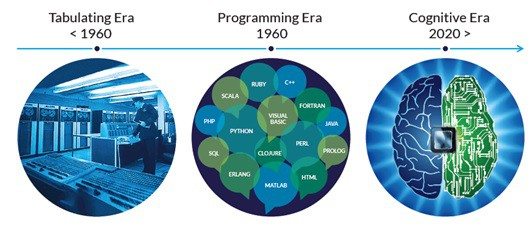
The Three Eras of Computing
Cognitive computing is modeled after the human brain (as the most powerful computing system in the world) and its thought processes in a computerized model. Cognitive systems are self-learning systems that simulate the way a brain works using data mining, analytics, pattern recognition, and natural language processing to learn, interact, and make decisions. During the Cognitive Era, computers will mature into learning systems. They will be able to understand data—or analyze, adapt, and suggest solutions based on data.
Cognitive technology is becoming a part of everyday life. Anti-lock braking systems, air bags, and crash avoidance systems are fully automated standard features in cars. Smart cities are optimizing performance by automating traffic flow, energy use, pollution, and transit systems. Prototypes for autonomous driverless cars are already on the road—and we have yet to enter the Cognitive Era.
The next two decades will see the development of next generation cognitive systems into enterprise systems, processes, and practices. Cognitive computing will push the limits of what is possible with technology. Digital enterprises of the future will incorporate cognitive tools and analytics into their infrastructures. They will be used to amplify human capabilities, working seamlessly alongside people to uncover underlying patterns and trends, provide insights, make decisions, and prescribe actions.
At OpenText, we see cognitive computing and machine-to-machine communications as the next big technologies on the horizon. They are an essential part of any comprehensive EIM platform, and they are part of the OpenText view of the World. But that’s a whole other topic of discussion…which I’ll address in my next post in this series.