

This Digital Revolution is not about job creation, it is about job destruction.
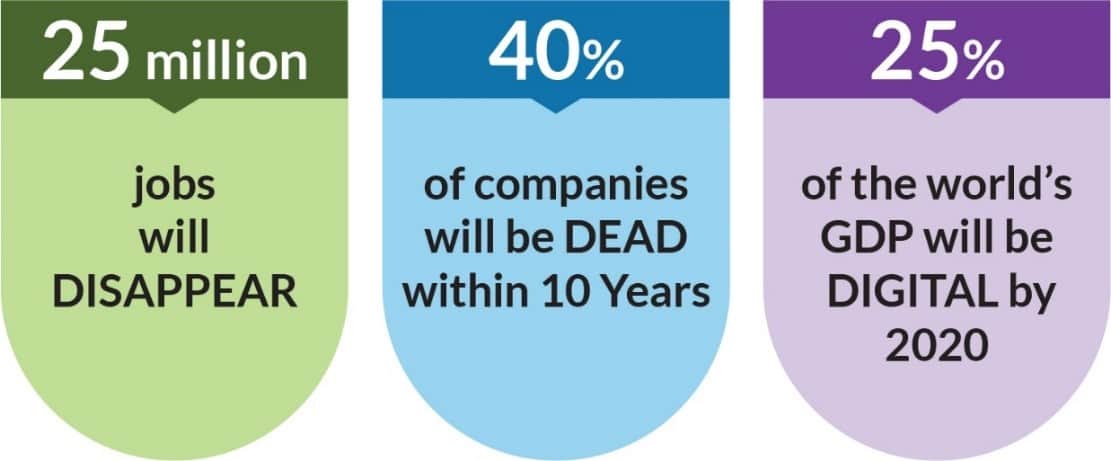
As many as 25 to 40 million jobs will disappear as a direct result of extreme automation and extreme connectivity. The greatest losses will occur in white-collar office and administrative roles.
Its Impact will be Profound
We experienced similar waves of automation when Material Requirements Planning (MRP) replaced Enterprise Resource Planning (ERP), and ERP shifted to CRM, and these were replaced by e-business suites. When this happened, jobs were created, many of which were offshore. New research shows that over the next two decades, nearly half of all jobs will be susceptible to automation.
The Digital Revolution will bring an increasing reliance on self-service technology, sensors, machine-to-machine (M2M) communication, and artificial intelligence (AI). These will transform the workplace as menial tasks and some non-routine jobs are digitized through robotics and process automation. These systems will make businesses more efficient.
AI will be pervasive. Based on advances in computing, automation will include the processing of languages, images, and data. As paper is removed and processes automated, clerical work will be eliminated. Other jobs that will be impacted include customer services, sales, and support.
Robotics and 3-D printing will render low- and even middle-skill-level jobs redundant. Extreme automation will make robotics more mobile, giving them a greater range of movement and functionality. M2M communications will enable machines to process data and make decisions based on this data as we move toward more intelligent, cognitive systems. In many cases, the intelligence that these systems deliver will be more accurate, immediate, and safer than humanly capable.
Digital is playing a larger role in our economy. By 2020, 25 percent of the world’s Gross Domestic Product (GDP) will not be touched by a human hand. This is significant. A quarter of the world’s GDP will be digital.
The economic impact of digital is vast. Internet maturity correlates with wealth creation. It is used by companies in every industry. Businesses that use the Internet tend to grow more quickly, export two times as much as those that don’t, and create more than twice as many jobs. Despite these statistics, many companies are off to a poor start on the journey toward digital transformation. While organizations are taking advantage of digital technologies, many economies remain digitally immature. This means that the ability to unlock the value of digital is far from being realized.
Key disruptive forces are impacting the enterprise on its journey to digital transformation. In my next post, we’ll take a closer look at these.