Five Highlights from the OpenText Government Summit
The Value of Trust was echoed throughout the day in keynotes and government panels.

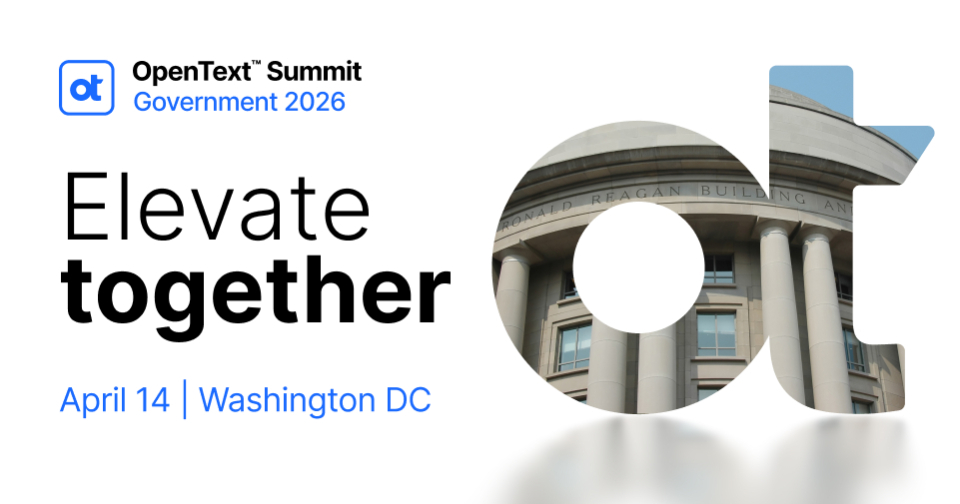
After a day of listening to inspirational speakers and panelists from government and industry (and Australia!), five key takeaways emerged, each dealing with trust in a slightly different way.
1) Government is embracing Trusted AI.
Matt Passos, Acting Chief Technology Officer at the Department of Commerce, emphasized the importance of trust and AI during his keynote remarks “Elevate Together: A Technology Playbook for Government Mission Success.” His formula for success: find a good pilot use case for AI – for example, summarizing public comments on proposed regulations, or drafting RFQs – and learn how AI can deliver a public service better.
The concept of trusted AI was echoed by each of the panelists in the panel “AI in Action: Turning Automation into Mission Success.” Rakeim Young, Chief of Staff for the Baltimore Mayor’s Office of Performance and Innovation, discussed leveraging AI to improve traffic flow, identify illegal dumping, and triage 311 calls. August Schell’s Chief Data and AI Officer Caroline Kuharske discussed strategies for having AI convert outputs from older systems into usable data to power better decision-making at defense agencies.
2) A Deep Dive into the Value of Trust
In his opening remarks, OpenText SVP for Worldwide DevOps and ITOM Sales Eric Baca described learning about the value of trust growing up in a military family. He stressed how the parallels of the trust relationships he saw at home have translated into how OpenText works with its customers.
In particular, OpenText’s commitment to government cloud security includes hosting seven distinct products in three listingson the FedRAMP marketplace. More products are on the way with help from the General Services Administration’s FedRAMP 20x initiative, which intends to grow the marketplace stratospherically, from its previous pace of a few dozen new products a year to several thousand. Scott Bourne of AWS said he thinks FedRAMP is at an infection point. “From an ISV perspective, when you brought up FedRAMP or public sector, the air went out of the room” due to anticipated heavy time and cost commitments. Dan Chandler, Cloud Security Engineer from GSA, said of FedRAMP 20x: “We’re not going to tell you how to build your product. If it’s secure, then demonstrate that to government, and then we’re good. Test it and show me the system is secure. That solves the trust problem.”
Victor Dominello, CEO of the Future Government Institute, described the evolution of government using a government form as a proxy for public sector technological maturity. Government 0.0 – the early 1990s and before – was a paper form filled out in ink, which evolved into an online web form to ultimately, no form at all – just a fully intelligent digital agent that can interact with a citizen directly (still maybe a decade away). To make the evolution successful, Mr. Dominello stressed the importance of trusting your constituents. “Technology needs to be useful and usable. It’s for everyone, not just the younger generation,” he said. He had the results to prove that theory. During his stint as Minister for Customer Service and Digital for New South Wales, Australia, his technology improvements resulted in 400% more customers served at an 81% lower cost per transaction, achieving $15 billion in direct savings to government.
Learn more about OpenText FedRAMP authorized solutions
3) Cyber, Zero Trust and AI Are Converging
Panelists on the “Resilience Blueprint and the Future of Cyber Defense” discussed how cyber threats are evolving faster than ever, and the government’s response must work even harder to stay ahead of its adversaries. Security experts from the Department of Transportation, General Accountability Office, and University of Maryland – Baltimore County discussed how their organizations are adapting to AI-powered threats using zero trust architectures and embedding resilience throughout their infrastructures, from identify management to threat detection.
In two of the afternoon breakout sessions, summit attendees learned about how OpenText cyber security solutions are assisting government agencies in dealing with the risks created from dark data and software supply chains. First, during the “Future of Data Discovery and Classification” session, attendees learned how government agencies overcome siloed structures, mis-classification and unmanageable volumes using OpenText data discovery, classification, and governance tools. Later in “DevSecOps in the AI era” OpenText experts demonstrated how its application security platform integrates seamlessly into development workflows, enabling early detection and remediation of vulnerabilities.
4) The Power of Trusted Data
A brief demonstration of OpenText’s agentic AI in action underscored the importance of trusted data to build successful AI. US Public Sector President Kevin Davis and Senior Director Mike Kremer found, built, tested and deployed an AI agent on the fly to process an insurance claim, generating a fully compliant, audit-ready report. A critical success factor was deploying inside a secure environment using trusted data, with no need to go outside the network where risk is increased.
Two other sessions highlighted the power of trusted data. OpenText US State and Local Government Director Simon Woodford explained how one state built a state-wide law enforcement system of background checks to mitigate the risk of “wandering officers” – a phenomenon where police officers are fired for misconduct, then move to a new county to get re-hired under false pretenses. In a different breakout, OpenText Senior Strategist Hilary Johnson discussed how the US Army Red River Depot deployed AI-powered IoT to streamline logistics and boost resilience of maintenance and operations around its fleet of armored vehicles.
“The friction point for AI is the data,” said Adam Terrill, OpenText Director of Defense and Intelligence. “It’s inoperable and inaccessible.” Adam joined Dr. Wanda Jones-Heath, Principal Cyber Advisor for the US Air Force, and Dave Raley, Marine Corps Chief Digital Business Officer on the panel “The Digital Edge: Building Secure, Scalable and Smart Operations.” The panelists discussed how data fragmentation remains a key challenge within many Department of War organizations, and how AI depends on accessible, high-quality data.
5) A formula for trust between government and industry
In his keynote remarks “GSA 2.0: The Roadmap for the Advancement of Government Services,” GSA Deputy Administrator Michael Lynch described the importance of trusted partnerships between government and industry. He discussed how OneGov is a case in point, where government-wide contracts achieve savings by addressing cost imbalances among certain agencies, while the benefit to industry is less resources needed around negotiations.
Major General David Fraser, an OpenText board member and co-author of “Enterprise AI: Building Trusted AI in the Sovereign Cloud,” shared lessons learned from his time commanding 10,000 personnel from seven countries as a NATO commander in Afghanistan. There he experienced the power of teams of teams and saw the critical difference that accurate information on the battlefield could make.
The trust theme contributed to a vision of a new model where industry and government worked together from the outset.
“I would love for us to get to a point where Operation Stormbreaker is available to a vendor and a DoW mission – I would love to see it ubitiquously available,” said Dave Raley, Chief Digital Business Officer, Marine Corps. “Having a place where vendors could start coding from scratch that already met all the high security standards would be a game-changer from a readiness perspective.”
Dozens of additional demos, panels and breakout sessions made up the remainder of the day.
Mission impact is the true north, and trusted data will lead to trusted AI. Add in top-level cyber security and trusted partnerships and mission impact will be felt for years to come.