
Enterprises are investing heavily in generative AI, but nearly all face common challenges: AI’s impact within your organization depends on its grounding and how much you trust it. If your content is disorganized, outdated, or hard to access, even the most advanced AI models won’t produce reliable results.
In a recent webinar, we discussed four practical aspects of automating AI readiness, and how solving these key issues help organizations move from ambition to practical results. We showed – in several demonstrations – how OpenText™ Knowledge Discovery and OpenText™ Content Aviator work together to operationalize AI readiness across the four essential pillars: discover, prepare, govern, and act.
Watch the webinar1: Discover — see across silos so AI can too
Many organizations already have strong content management and information governance practices. However, critical content is spread across multiple repositories—such as Microsoft 365, file shares, line-of-business systems, and archives—each posing challenges for safe AI grounding and meaningful AI-driven interactions. Additionally, these repositories may contain hundreds of different file formats, including legacy formats, CAD files, and rich media like video and audio.
OpenText Knowledge Discovery works naturally with these systems, providing connectivity, extracting content and metadata form over 2,300 file formats, and providing valuable intelligence, organization, and information protection that is necessary for a sound and successful AI strategy.
See it in action:
In our webinar, we showed how OpenText Knowledge Discovery provides a cross-repository view, surfacing content that would otherwise be hidden or opaque to both everyday users and AI. This is the groundwork for every AI use case, from search to AI assistants to automation.
2: Prepare — transform unstructured content into AI-ready intelligence
AI struggles when content is incomplete, inconsistent, or locked inside formats it cannot interpret. When AI is forced to ground itself in low-quality information, the result is hallucinations, rework, and eroding trust.
OpenText Knowledge Discovery addresses this by enriching content at scale:
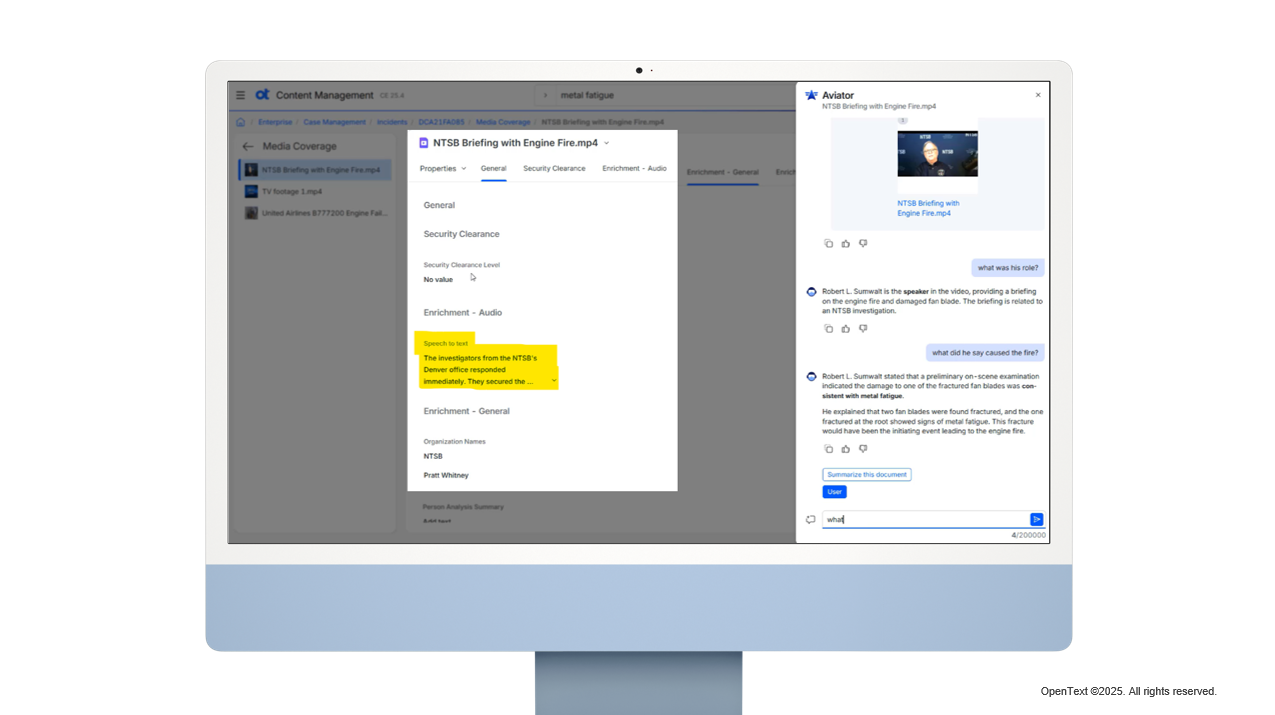
- Converting audio and video into time-aligned transcripts
- Applying OCR to scanned PDFs and images
- Detecting objects, speakers, entities, and relationships
- Adding semantic metadata and category labels
- Normalizing formats so AI can understand the full meaning
These enrichment steps make OpenText Content Aviator significantly more accurate, because its grounding information is structured, complete, and contextually relevant.
See it in action:
We demonstrated how a live meeting recording audio file becomes a fully searchable asset enriched with metadata, instantly usable by AI assistants and investigators.
3: Govern — embed policy into content before AI uses it
Governance cannot be bolted on after AI has already accessed your information. It must live in the content layer.
In the webinar, we discussed how AI cannot infer confidentiality or compliance. It needs governed, policy-aligned content to operate safely. OpenText Knowledge Discovery enables this by:
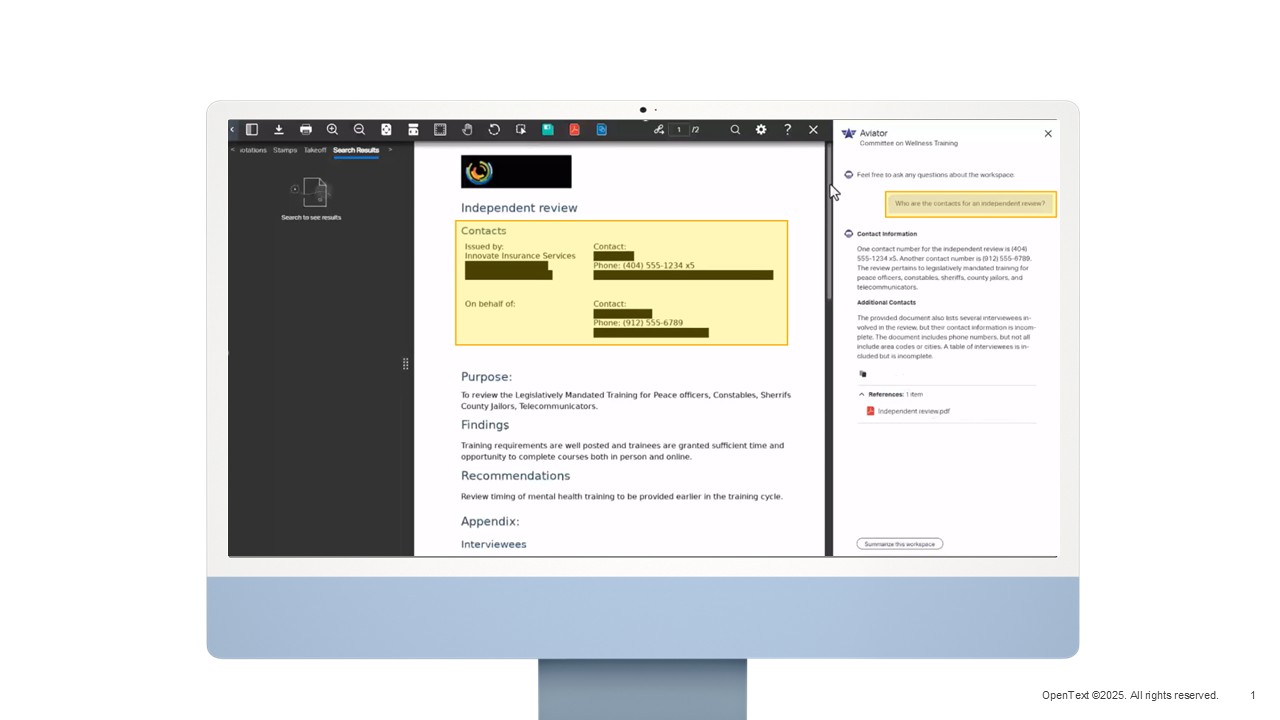
- Detecting PII and sensitive data
- Applying labels that reflect risk and regulatory requirements
- Supporting redaction workflows
- Enforcing repository-level access rules automatically
- Ensuring that AI systems, including OpenText Content Aviator, only retrieve content a user is permitted to see
This is where AI readiness and AI governance converge. AI becomes safer not because models behave differently, but because content is governed before AI touches it.
See it in action:
We showed how OpenText Knowledge Discovery identifies sensitive information and automatically creates a policy-aligned, redacted version, ready for safe use in AI and human workflows.
4: Act — deliver AI in context with Content Aviator
The goal of AI readiness is action: enabling AI to participate meaningfully in business processes.
OpenText Content Aviator works best when it’s grounded with a contextually-rich knowledge graph. OpenText Content Aviator doesn’t search blindly. It draws from enriched, governed content sets prepared by OpenText Knowledge Discovery.
This allows AI to:
- Understand workspace-specific context
- Provide grounded answers with citations
- Accelerate investigations, case work, and knowledge search
- Reduce manual effort through suggested actions and next steps
With governed, AI-ready content underneath it, OpenText Content Aviator becomes a trusted partner in day-to-day decisions.
See it in action:
We saw OpenText Content Aviator answer questions about a specific case by referencing enriched content and presenting citations, giving users full transparency.
Why OpenText Knowledge Discovery is central to AI readiness
AI readiness is not a one-time cleanup project. It is a continuous discipline. As your content evolves, so must the processes that enrich, classify, and govern it. OpenText Knowledge Discovery operationalizes this work at scale. It keeps content fresh, connected, and protected, so your organization can adopt AI responsibly and with confidence.
And when paired with OpenText Content Aviator, it turns AI readiness into real-world impact.
To see the demos, real examples, and expert discussion on how enterprises are accelerating AI readiness today, watch the on-demand webinar.