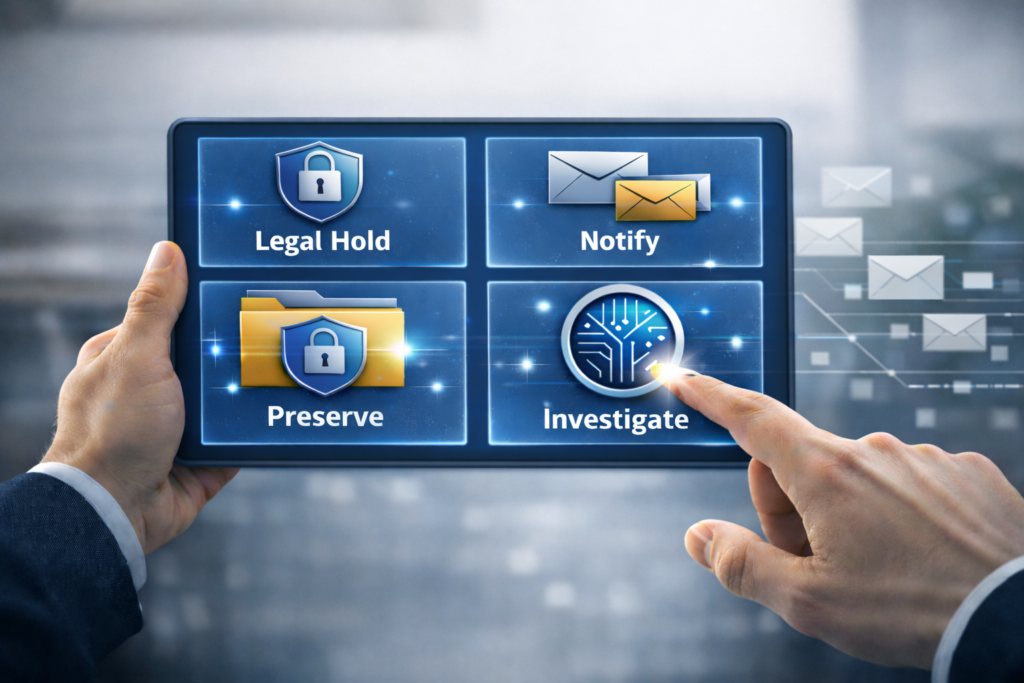
Despite budgetary pressures and increasing caseloads, legal departments are being asked to do more with less. Recent data suggests that over half (56%) of in-house departments are under-resourced, even though almost half (46%) say they expect to see more work being shifted in-house. To address these challenges, 73% said they planned to use advanced legal technology solutions to automate legal tasks and reduce costs.1 The objective: run the department smarter, faster, and leaner. As a result, we are seeing one of the most important shifts in enterprise legal today – more self-service to support eDiscovery litigation and investigation activities.
This blog explores this move to self-service, why many current models fall short, and what true self-service in legal department technology and eDiscovery should look like in 2026 and beyond.
The shift towards legal tech self-service
Self-service models are designed to address ongoing cost pressures, handle more work with limited resources, overcome operational IT dependency that slows many early-stage workflows, and exert more control over eDiscovery workflows.
A strong self-service model drives legal teams to act faster on standard tasks while still preserving auditability and defensibility. It should help in-house counsel and legal operations professionals to get to the facts faster, without long chains of requests, manual intervention, and bottlenecks. Too often, legal teams are frozen: process dependent on IT, vendors, and disconnected solutions when early decisions matter most. The result is slower response times and delayed access to the insight legal needs before outside counsel is engaged.
Why many current “self-service” models still fall short
A great deal of current self-service messaging focuses on access to tools. But access alone is not the same as operational independence. The real gap is not access. It is execution. Legal should not have to wait on IT every time it needs to preserve data, advance a collection step, monitor status, or move into early case assessment (ECA). Once that foundation is in place, legal should be able to run standard workflows with far less repeated IT intervention. If legal teams cannot, the department has not achieved self-service. It has created a modernized hand-off model.
That is especially true in enterprise eDiscovery software and litigation support, where early-stage workflows often cross multiple systems, repositories, and stakeholders. Every handoff adds time. Every manual step introduces inconsistency. And every dependency makes it harder for legal to respond quickly and defensibly. True self-service requires legal teams to move matters forward without routine IT intervention. This is especially true for the earliest stages, when preservation, collection, and early understanding of the facts need to happen quickly.
Why legal hold alone is not enough
Legal hold is one of the first activities that legal teams have historically attempted to manage themselves, and for good reason. Preservation is foundational. It matters for defensibility, and improvements there can have an outsized impact on early response.
Too often, enterprise self-service workflows start and stop at the implementation of legal hold software. While preservation is critical, that activity alone does not help legal teams answer the next set of questions that shape investigations and litigation strategy. Self-service has to extend beyond legal hold management into ECA and earlier visibility into the facts. In other words, self-service has to connect preservation to case insight. That is the difference between a workflow that merely preserves data and one that helps legal act decisively. If the process stops at preservation, legal still lacks a direct path from action to understanding early enough to drive strategy and provide direction to outside counsel.
This is also where platform limitations can expose the gap between basic workflow coverage and a truly defensible operating model. As discussed in my earlier blog on Microsoft Purview, enterprise legal teams cannot assume one platform will deliver complete, end-to-end self-service for complex legal workflows. What matters is whether legal can move from legal hold to collection, early assessment, and case insight without gaps in process, stalling out in more handoffs or more dependency on IT for task execution.
Legal needs less IT dependency, not less involvement
While the goal of self-service is to reduce the legal department’s day-to-day operational dependency on IT, IT remains a critical partner. Legal and IT continue to collaborate to define requirements, identify gaps, and ensure selected solutions integrate with internal systems, repositories, and other key data environments and architectural standards.
In fact, the relationship between IT and Legal is growing. According to a new Foundry MarketPulse survey of roughly 200 senior IT professionals, 68% of IT leaders indicated their involvement in selecting legal department technology. Sixty percent said IT helps map solutions to existing systems, and 59% said IT helps evaluate ROI. It also cited survey data showing that 39% of IT decision-makers identified legal hold process management as a key area of active IT–Legal collaboration. Defining these roles and objectives goes a long way to achieving the right level of self-service instead of the potential hand-off fumbles and turnovers.
From legal hold to case insight
If legal departments want true self-service management of eDiscovery activities, the answer is a more integrated workflow that connects legal hold, collection, early assessment, and insight. That is how legal moves from preservation alone to a smarter self-service model: one that helps teams surface key facts sooner, reduce risk earlier, and make stronger decisions before costs escalate.
This is where Case Intelligence comes in. By unifying legal hold, data collection, and early case assessment in a connected workflow, this eDiscovery solution helps legal teams go beyond preservation and gain earlier access to the key players, facts, issues, and evidence that shape strategy to understand the facts within hours rather than weeks.
See the full picture: explore what self-service can look like
Legal departments need a more integrated approach to move from preservation to assessment to early insight with less operational friction.
If your team is rethinking its self-service strategy, register for Corporate Counsel Business Journal’s May 19th Tech Talk, “From Legal Hold to Case Insight: Self-Service, Done Smarter” to see how OpenText Case Intelligence supports this connected workflow.
Don’t miss us at CLOC Global Institute in Chicago from May 11-14th. Stop by booth #506 to learn about how we’re helping legal ops professionals shape stronger teams, smarter processes, and spark innovation that improves operational excellence.
Ready to get started? Contact us to learn how leading legal hold software and eDiscovery AI solutions like OpenText Core Legal Hold with Case Intelligence can work for your organization.
- [1] 2025 Thomson Reuters Institute, Legal Department Operations Index.