e-Invoicing mandates and updates: Spain

March 2026
Factura’d In: What Spain’s B2B e-Invoicing mandate means for you!
The “regulatory tsunami” has officially reached the Spanish coast
On 24 March 2026, Spain’s Council of Ministers formally approved the long-awaited Royal Decree implementing mandatory B2B e-invoicing under Law 18/2022 – better known as the Crea y Crece (“Create and Grow”) Act. If you’ve been watching this space, you’ll know it’s been a long time coming. Now that the decree is signed, sealed, and factura’d, businesses operating in Spain have a much clearer roadmap for compliance.
Spain is joining a growing list of EU nations – including Belgium (Jan 2026), France (Sep 2026), Germany (Jan 2027) – that are moving toward mandatory structured electronic invoicing. But what does this latest decree actually mean for your business? Let’s break it down.
What is the new mandate?
Spain is transitioning to a mandatory B2B e-invoicing system for all taxpayers with a Spanish establishment. This isn’t just about sending a PDF via email; the mandate requires structured electronic invoices — in UBL, Facturae, CII, or EDIFACT formats — that allow for automated processing. All invoices must be transmitted either through approved private e-invoicing platforms or a free public solution operated by Spain’s tax authority, AEAT.
There’s also a notable new requirement: businesses must report the lifecycle status of every invoice — issuance, acceptance or rejection, and the actual payment date. Oh, and QR codes are mandatory too, enabling digital tracking at every step. It’s giving “scan to pay” a whole new compliance dimension.
This is all part of a broader effort to increase transparency, reduce Spain’s VAT gap — estimated at a hefty €6.8 billion in lost revenues — and put an end to Spain’s chronic late payment problem, where the average delay currently sits around 80 days.
Think of it as a tapas spread, not a single dish
Here’s where Spain gets more interesting — and more complex — than your average e-invoicing rollout. The Royal Decree doesn’t arrive alone. It’s one plate in a wider compliance tapas spread, and you’ll want to know what you’re ordering.
Plate one — Crea y Crece (the e-invoicing mandate): This governs how invoices travel between businesses. Structured formats, approved transmission platforms, lifecycle status reporting. This is the heart of the new decree.
Plate two — VeriFactu: Running in parallel, this anti-fraud requirement under Royal Decree 1007/2023 governs how invoices are created inside your systems – tamper-proofing, audit trails, certified billing software. It’s anticipated to take effect in January 2027, and it’s primarily a conversation to have with your ERP or accounting software vendor.
Two distinct plates, both important – but they’re served from different parts of the kitchen. Your billing software provider can help you with VeriFactu. What they almost certainly can’t help you with is the transmission complexity of Crea y Crece – and even less so when you factor in the many other mandates your business is likely navigating across the rest of Europe and beyond. That’s where the tapas dishes start to fill the table and lead to indigestion for your tax and technical teams.
The timeline: when do you need to act?
The exact start dates are tied to the publication of a Ministerial Order expected before 1 July 2026, which triggers the compliance countdown:
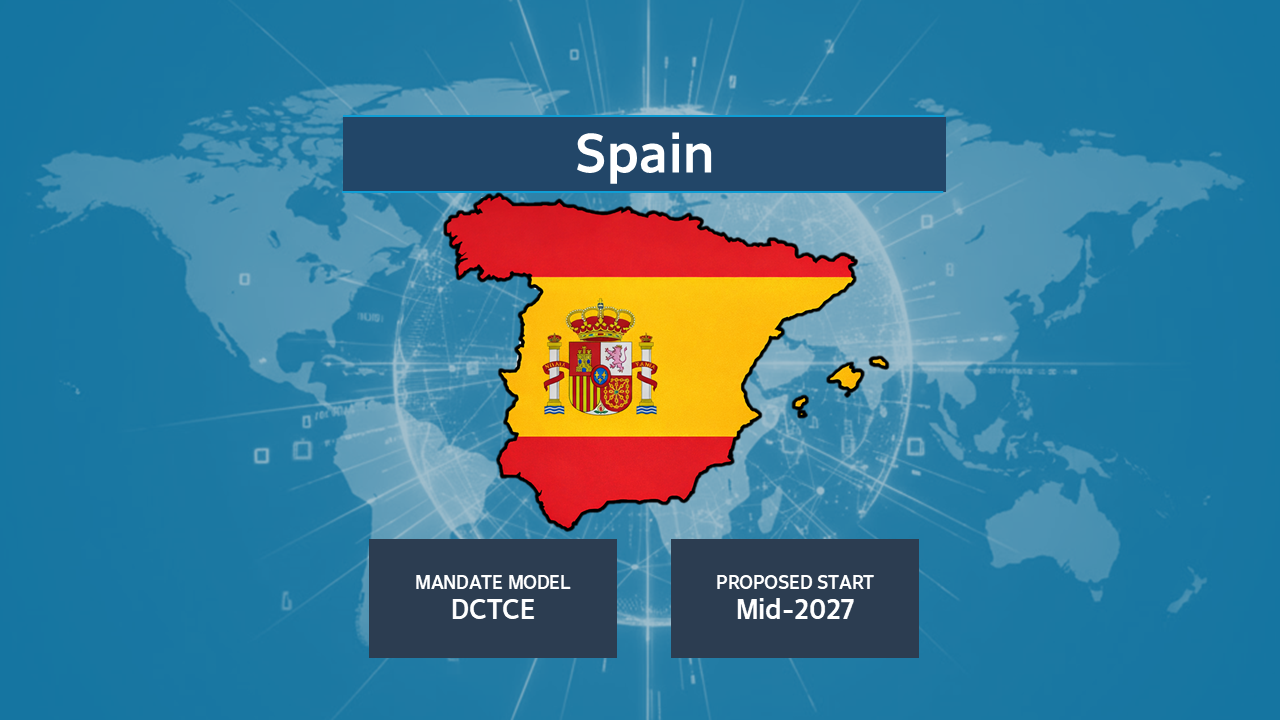
Large companies (annual turnover above €8 million): 12 months from the Ministerial Order – approximately mid-2027 if all goes according to schedule.
SMEs, micro-businesses, and self-employed: 24 months from the Ministerial Order — approximately mid-2028
If you’re a large enterprise, the clock is already ticking. If you’re smaller, you have a little more breathing room — but not as much as you might think once you factor in the system integration and testing work involved.
Why this matters: the carrot and the stick
We often use this framing when it comes to e-invoicing, and Spain is a textbook example.
The stick: Non-compliance carries significant administrative fines. In some jurisdictions these run from €2 to €15 per invoice – which adds up fast when you’re processing thousands of transactions a month.
The carrot: This is a genuine opportunity to digitise your order-to-cash and purchase-to-pay processes. Automated e-invoicing can reduce costs by 60–80% and shrink invoice cycle times from weeks to days. And with Spain specifically targeting that 80-day average payment delay, faster and more traceable invoicing means faster cash in the door – which is a carrot worth chasing.
The integration challenge: where it gets really spicy
For businesses operating in a single country with a single ERP, Spain’s mandate is manageable. But for multinationals, this is where things heat up. Spain is just one country. You’re no doubt also managing mandates in France, Belgium, Germany, Italy, and likely a dozen others over the next few years – each with their own formats, platforms, archiving rules, and timelines.
Your accounting vendor may sort out VeriFactu for your Spanish entity. But they won’t be coordinating your global invoice flows across 20 countries, translating formats on the fly, managing compliant archiving in each jurisdiction, and keeping pace as mandates evolve.
The OpenText Trading Grid e-Invoicing platform provides a single connection that handles any-to-any format translation, ensures integrity and authenticity and manages compliant legal archiving – across Spain and every other mandate on your compliance menu.
How to get started
Don’t wait for the Ministerial Order to land before you start preparing – it’s only a few months away. We recommend the following:
Assess your data: Use our e-Invoicing Readiness Check service to analyse your ERP file layouts against Spain’s specific requirements, including UBL format compatibility and lifecycle status reporting.
Separate the plates: Clarify your obligations under both Crea y Crece and VeriFactu — they’re related, but they’re not the same, and they need different solutions.
Think globally: Don’t solve Spain in isolation. Map your full mandate footprint and look for a single partner who can handle the whole spread.
Consolidate: The businesses that turn compliance into a competitive advantage are the ones who stop managing 20 vendors and start managing one.
Spain’s Royal Decree is a significant milestone — but it’s also a prompt to take stock of your global e-invoicing posture. We’re here to help you order from the full menu and make sure nothing goes cold.
July 2023
Draft regulation moves a step closer to B2B e-Invoicing mandate
Spain has moved a step closer to implementing mandatory B2B e-Invoicing with the publication of a draft Royal Decree, which forms part of the “Crea y Crece”, or Law for Creation and Growth of companies published initially in September 2022. The proposed legislation aims to promote digitization, reduce late payments and cut administrative costs for businesses, particularly smaller companies.
While the regulation is still in the draft stage, it offers crucial insights into the scope, requirements, and timelines of the upcoming e-invoicing system in Spain.
Key Points:
- Scope of the Spanish B2B E-Invoicing Mandate: All companies and professionals required to issue invoices under Spanish law will be obliged to do so electronically. Some excluded transactions include simplified invoices and cases where there is no legal obligation to issue an invoice under Spanish rules. The mandate is for domestic e-Invoices only and does not apply if one of the parties is not established within Spanish territory.
- Main Requirements of the Spanish E-Invoicing System: The system will consist of privately owned electronic invoicing platforms and a public electronic invoicing solution managed by the State Tax Administration Agency. E-invoices can be issued in different accepted formats, and an advanced electronic signature is mandatory for integrity and authenticity. All e-invoices must be identified with a unique code, and the recipient must communicate the acceptance or rejection of the invoice and the payment date.
- Accepted E-Invoice Formats: E-invoices will be structured documents and will no longer include PDF formats. Taxpayers must issue e-invoices using accepted formats such as XML CEFACT/ONU, UBL, EDIFACT, or Facturae. Private e-invoicing platforms must be capable of converting e-invoices into all supported formats while preserving integrity and authenticity.
- Communication of E-Invoice Status: The recipient of an e-invoice must communicate its status within four calendar days. Mandatory statuses include commercial acceptance or rejection and full effective payment. Optional statuses include partial commercial acceptance or rejection, partial payment, and assignment of the invoice to a third party.
- Implementation Timelines: The draft regulation will come into effect 12 months after its official publication in the Spanish Official Gazette (BOE). The deadline for compliance is 12 months for entrepreneurs and professionals with an annual turnover over €8 million, and 24 months for others. Reporting of e-invoice statuses will become mandatory 36 months after the publication for entrepreneurs below €6 million and 48 months for professionals below the same threshold.
While the draft regulation for mandatory B2B e-invoicing in Spain is subject to changes before its final publication, it provides businesses with crucial information regarding the upcoming e-invoicing system.
Businesses and professionals were invited to provide feedback on the draft until July 10, 2023, as the government finalizes the details and seeks a derogation from the EU VAT Directive.
More details as well as a the full text of the decree (in local language) can be found on the Spanish Directorate of Economic Policy website.