September 2025
Proposal underway: VAT reporting amendments & e-invoicing tweaks
Croatia moves to fine-tune Fiscalization 2.0. The government proposes changes to the VAT Law to align e-invoicing rules with VAT reporting cycles and simplify administration. Public consultation is open, and adoption is expected before year-end.
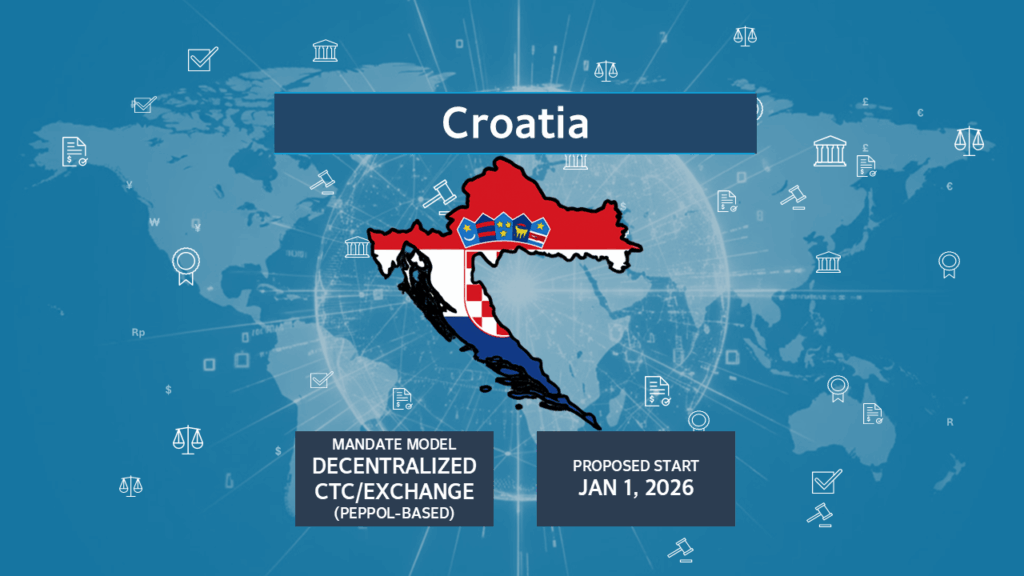
The start date stays firm: January 2026. Businesses now need to check how these adjustments affect invoice data flows and reporting processes.
June 2025
Croatia’s Parliament Approves Fiscalization 2.0 – Technical Specs Now Available
The Croatian Parliament has now approved their Fiscalization 2.0 law on 11 June 2025, confirming mandatory B2B e‑invoicing from 1 January 2026 and extending the mandate to non‑VAT entities and the public sector from 1 January 2027.
Following approval, the Croatian Tax Administration and FINA have published the official technical documentation, which includes:
- The UBL‑based e‑invoice schema with Croatia’s CIUS extension (HR‑FISK 2.0).
- Specifications for secure message exchange, including SOAP/XML web‑services, digital signatures, and certificate requirements.
- Details of endpoints for test and production environments, plus message formats for invoice submission and status checks.
The full documentation is available on FINA’s official portal:
Technical specifications – Invoicing for web services
Given the very short timeline, businesses should now review these specifications and ensure their readiness. The test environment is scheduled to go live on 1 September 2025, ahead of the January 2026 mandate.
Please contact your OpenText representatives to see how we can assist you in your preparations and help you ensure compliance with the impending mandate.
April 2025
Public Consultation Closes – What’s Next for Croatia’s e‑Invoicing Mandate?
Croatia’s public consultation on mandatory B2B e‑invoicing closed on 28 March 2025. The Ministry of Finance is now reviewing feedback and is expected to finalize the legislation in the coming months.
Timelines remain unchanged:
- 1 September 2025 – test environment goes live.
- 1 January 2026 – mandatory e‑invoicing for VAT‑registered businesses.
- 1 January 2027 – mandate extended to non‑VAT entities and the public sector.
Next steps include publication of technical specifications and final decree details, anticipated by mid‑2025. Businesses should use this time to prepare for integration and testing to ensure compliance from day one.
March 2025
Croatia Opens Public Consultation on Mandatory B2B e‑Invoicing
The Croatian Ministry of Finance has launched a public consultation on its proposal to mandate e‑invoicing for VAT‑registered businesses. The consultation runs until 28 March 2025, giving stakeholders a short window to provide feedback.
Key points from the draft:
- Mandatory e‑invoicing for domestic B2B transactions from 1 January 2026.
- Non‑VAT entities and public sector bodies to comply by 1 January 2027.
- Real‑time reporting of invoice metadata to the Tax Administration.
- A test environment will be available from 1 September 2025 to help businesses prepare.
Businesses should review the proposal and submit comments before the deadline. Early preparation for system integration will be critical ahead of the September test phase.
January 2025
Croatia unveils e-invoicing mandate under Fiscalization 2.0
The Croatian Deputy Prime Minister confirms mandatory e-invoicing will launch in 2026 as part of their Fiscalization 2.0 project.
The scope includes B2B and B2G transactions, and certain cash/business transactions.
The mandate will enforce the use of structured electronic invoice formats—PDFs are explicitly out of scope.
At this stage we don’t have any technical details to share, but will follow up as soon as we do.
October 2023
Croatia seeks EC approval for B2B invoice regulation
Croatia’s Tax Authority has formally requested EU Commission approval to mandate domestic B2B e-invoicing from January 1, 2026.
This marks the first formal step toward an e-Invoicing mandate.
More news about technical specifications will follow when we have it.
Disclaimer: This newsletter is intended to reflect the direction the industry is moving and does not a reflect a commitment for the OpenText Active Invoices with Compliance (AIC) product development roadmap to meet any particular stated regulations.
LEGAL Disclaimer: The information contained in this newsletter is for general guidance on matters of interest only. The authors are not herein rendering legal, accounting, tax or other professional advice and the content should not be used as a substitute for consultation with professional accounting, tax, legal or other competent advisers. While we make every attempt to ensure the accuracy of the information contained within is from reliable sources, OpenText is not responsible for any errors or omissions, or for any result