
The network management landscape is evolving fast in 2026. Hybrid cloud environments are growing more complex. The number of IoT devices continue to climb. And organizations increasingly need intelligent automation to keep their critical network infrastructure running. These trends are driving demand for platforms that consolidate visibility, control, and automation into a single network management solution. OpenText™ has established itself as a leader in this space. Here’s what’s driving that position.
ℹ️ The ESSENTIALS – If you’re new to these topics, start with the fundamentals: “What is network management?” and “What is network observability?”
OpenText™ Network Observability provides centralized visibility, control, and automation across entire networks, whether physical, virtual, software-defined, or cloud. It delivers end-to-end insights across on-premises and cloud environments to help you quickly resolve performance issues, strengthen security and compliance through automated configuration and change monitoring, and run proactive diagnostics before problems affect users.
What network monitoring capabilities does OpenText have?
You can’t manage what you can’t see. OpenText delivers enterprise-grade network performance monitoring that consolidates fault monitoring, performance monitoring, syslog analysis, and topology discovery into a single platform. Using patented, real-time continuous Spiral Discovery, the platform automatically maps your entire network infrastructure, and keeps that topology accurate as devices, connections, and configurations change.
The platform collects data through SNMP polling, streaming telemetry, cloud APIs, and REST-based custom collection to deliver real-time insights across physical, virtual, SDN, and public cloud environments. Smart plug-ins (SPIs) provide deep visibility into firewalls, wireless access points, VPN tunnels, and other specialized infrastructure. The 26.2 release adds performance monitoring for Cisco Viptela SD-WAN overlays, delivering metrics for volume, rate, utilization, and latency across overlay tunnels to help teams proactively identify degradation before it impacts users. This consolidated approach helps network operations center (NOC) teams reduce mean time to repair (MTTR), optimize performance, and maintain accurate network topology maps with extensive multivendor support.
OpenText network management software watches over some of the largest enterprise networks in the world, scaling to environments with over 120,000 discovered nodes and 1,000,000 interfaces per global domain.
What network automation capabilities are included?
Manual network device configuration is slow, error-prone, and risky. A single mistyped IP address or firewall rule can cause a major outage or a security breach. The OpenText network automation capabilities eliminate that risk by automating the entire lifecycle of network device management: provisioning, policy-based configuration, compliance auditing, and security updates.
The platform stores every device configuration, compares it to the current running state, and can roll back unwanted changes automatically. For teams adopting NetDevOps practices, built-in Git and Ansible integrations let you create, test, and deploy automation workflows through version-controlled pipelines. This approach boosts network stability, accelerates resolution, and reduces manual errors across multivendor environments.
What does OpenText offer for cloud network observability?
Traditional network monitoring tools were built for data centers. They struggle with the dynamic, distributed nature of cloud, and hybrid cloud networks. OpenText’s cloud network observability capabilities closes that gap by delivering actionable insights into the complex environment of hybrid and multicloud networks. This fundamentally enhances traditional network monitoring by addressing the critical “why” behind performance issues, not just the “what.”
Does OpenText have synthetic testing?
If there’s no traffic on your network, how do you know it works? Synthetic network testing proactively monitors performance by running continuous checks, even across networks you don’t directly control. You can monitor latency to SaaS services or measure performance between two regions of any public cloud provider. So, you’ll receive an alert about a network problem before anyone reports it.
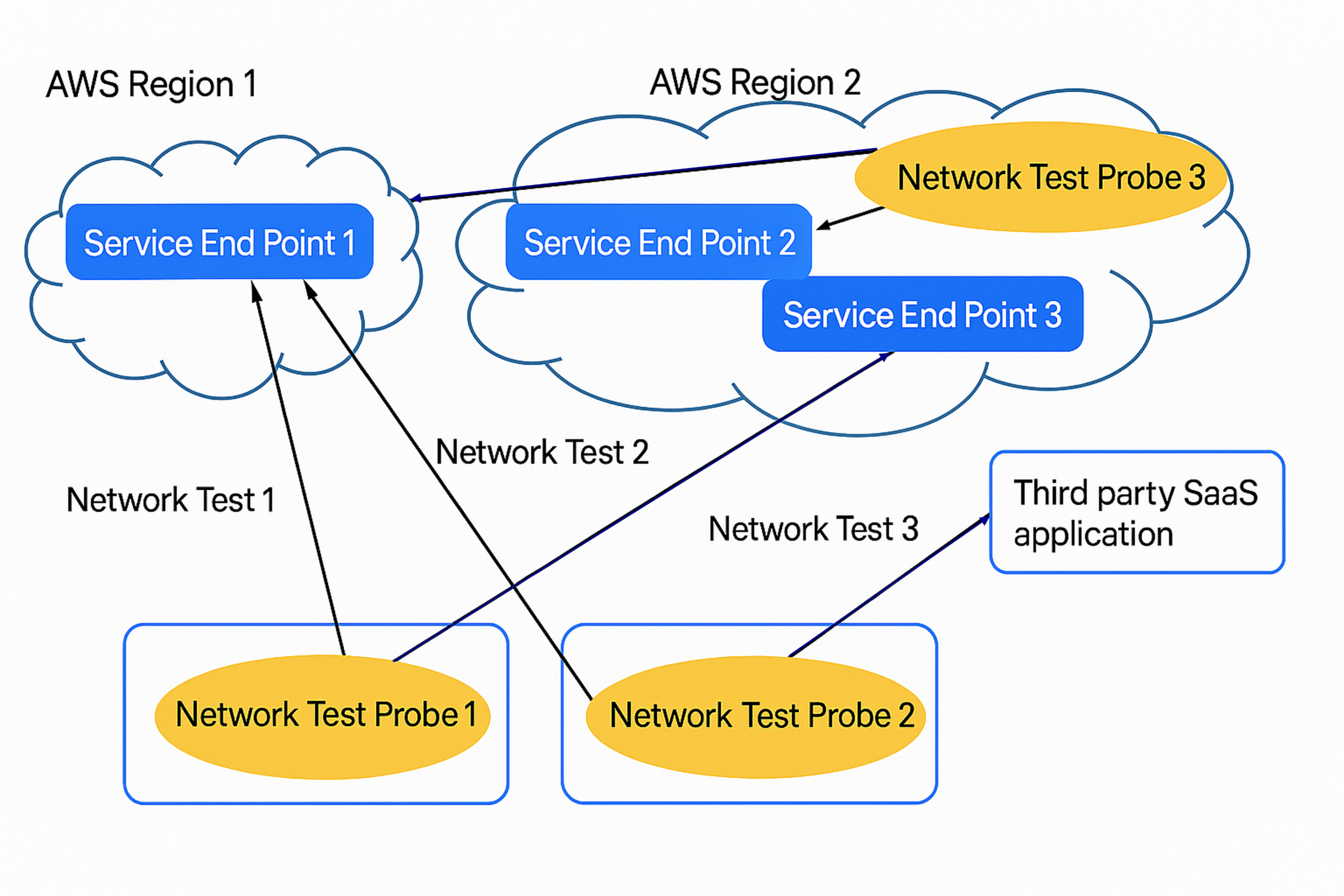
Cloud flow and hybrid topology maps
Monitoring traffic between your data center and the public cloud has traditionally been a blind spot. OpenText Network Observability provides a clear view of traffic patterns within public clouds (AWS, Azure) and across hybrid environments. By ingesting native cloud services like AWS and Azure Flow Logs, the platform generates dynamic flow overlays on network topology maps. You can see exactly who is talking to whom, which protocols they’re using, and whether traffic was blocked by a security group, or a network ACL misconfiguration.
This visibility is a major reason the platform has helped customers achieve 50% faster issue resolution. Instead of digging through raw logs, administrators use real-time, and historical flow data to proactively detect bottlenecks, improve application response times, and spot data transfer patterns that lead to unexpected cloud cost overages. When packets drop, deep diagnostics pinpoint the cause (a blackhole, an MTU mismatch, a missing route) so you get the root-cause visibility needed to keep the network stable.
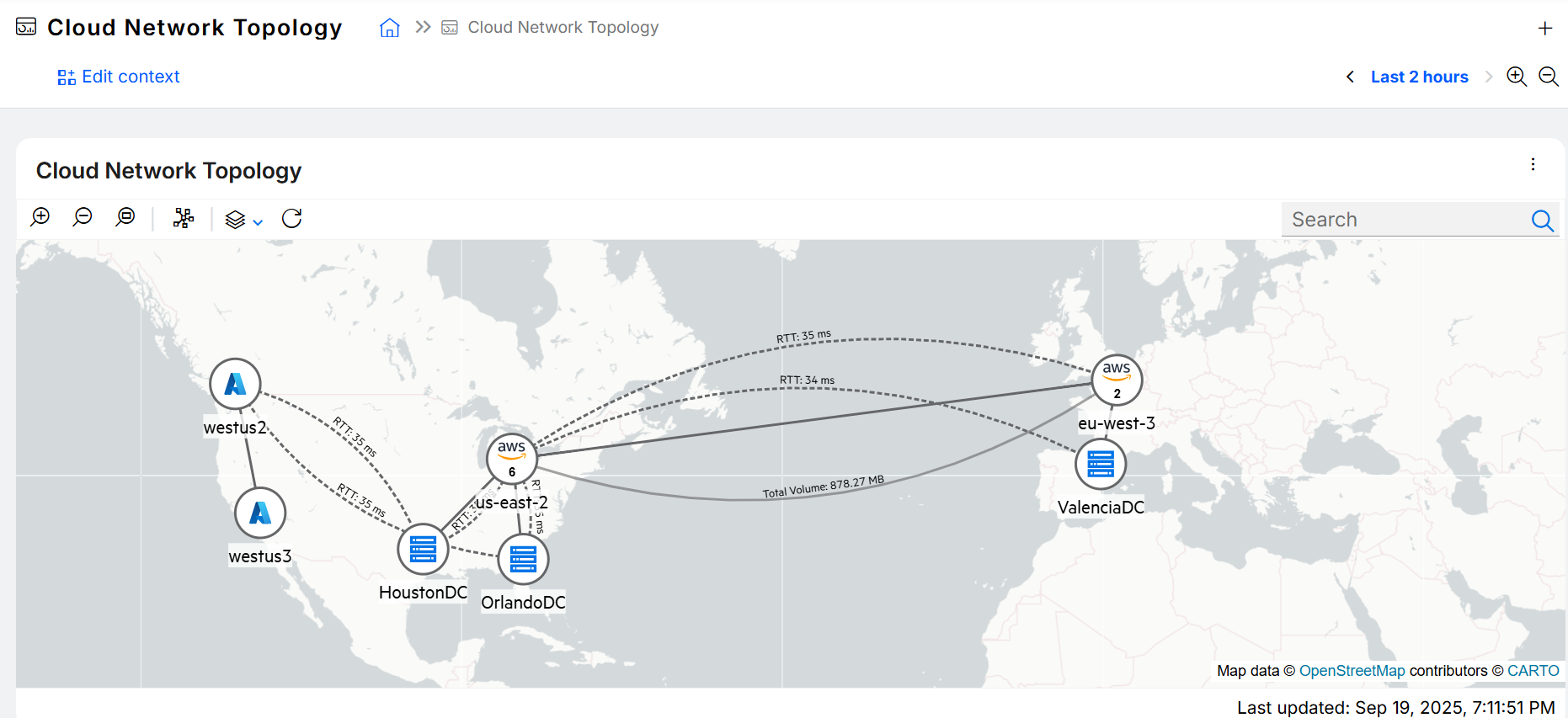
A common challenge today is that cloud teams use AWS and Azure native tools while core NetOps teams use on-premises network management tools. This creates a gap in coverage between cloud and on-premises networks. OpenText Network Observability bridges that gap.
The unified advantage: Our strength is the seamless integration of cloud network observability with on-premises network monitoring and network automation. This creates a unified, hybrid network control plane that no point-solution vendor offers. You get one topology map, one data set, and one set of automation tools to manage everything from the firewall in your data center to the connections in the cloud.
What is monitoring for change and why does it matter?
Research shows that 80% of MTTR is spent figuring out what has changed. OpenText Network Observability addresses this with a capability called “monitoring for change”, which tracks every network configuration change in real time, and correlates it with performance, availability, and fault data. When something breaks, your team can immediately see which change triggered the issue, dramatically reducing the time spent on root-cause analysis.
This isn’t a separate module or add-on. Change-aware troubleshooting is built into the platform, giving network teams the context they need to resolve incidents faster, and prevent repeat issues. It’s a key reason why OpenText customers report resolving issues up to 50% faster than with their previous tools.
What multivendor network support does OpenText deliver?
Enterprise networks are heterogeneous by nature. OpenText supports 3,500+ device types across 250+ vendors, allowing you to manage your entire network infrastructure from a single platform. The platform normalizes syslog, topology, and flow data across vendors, so you don’t have to. Whether you’re running Cisco, Juniper, Palo Alto Networks, Aruba, Fortinet, F5, Check Point, Huawei, Citrix, HPE Networking, or dozens of other vendors, OpenText provides consistent visibility, and control. Learn more about what OpenText network management encompasses.
AI-powered network operations
OpenText is embedding AI directly into network operations workflows through OpenText Aviator.
AI-assisted intent-based diagnostics interpret the intent behind a network event and suggest targeted diagnostic actions, helping teams move from alert to root cause faster. Instead of manually correlating alerts with possible causes, operators get contextual recommendations that point them toward the most likely source of the issue.
These capabilities build on the broader OpenText™ AI Operations Management platform, which uses AI-driven event correlation (including network events) to reduce noise and accelerate root-cause analysis across the full IT estate.
What advanced features does OpenText have for modern networks?
REST API integration: The platform enables broader visibility by leveraging REST APIs to collect data from third-party tools and external sources, extending observability beyond traditional network devices.
Advanced firewall and security monitoring: Gain insight into firewall functions, virtual systems, VPN tunnels, and performance metrics for faster fault detection, and resolution. Deep monitoring support includes Palo Alto Networks, Check Point, Fortinet, Cisco FirePower, and other leading firewall vendors.
Security compliance and vulnerability management: Enforce continuous security through policy-based automation that streamlines security updates and compliance auditing. The platform tracks configurations, running state, and OS versions against industry standards (GDPR, HIPAA, NIS2, PCI, SOX). It can also scan for devices running vulnerable OS versions using the Exploit prediction scoring system (EPSS).
Role-based access control (RBAC): Reduce operational risk with robust access controls supporting SAML 2.0, LDAP, RADIUS, PKI, and FIPS 140-2-validated cryptographic modules.
Managed private cloud deployment: OpenText Network Observability delivers a private cloud deployment option for all network management capabilities. Network teams gain instant value through always-current deployments, getting new features quickly without the burden of installation, upgrades, and maintenance.
How is OpenText Network Observability deployed?
Deployment flexibility is a key differentiator. With the 26.2 release, OpenText Network Observability is now available as a SaaS solution in the OpenText cloud, or as a self-hosted, on-premises deployment with perpetual licensing. This means enterprises that need to keep data and operations on-site get the same unified monitoring, automation, and compliance capabilities available in the SaaS deployment, without compromising on control, or licensing flexibility.
The platform uses a modular, use-case-based pricing model. You activate only the capabilities you need (integrated monitoring, hybrid cloud observability, configuration management, security and compliance, automation and orchestration) and pay accordingly. No forced bundles, no shelfware. This flexible approach reduces costs and ensures you get maximum value from the platform.
What results and benefits have customers seen?
Here are a few examples of the measurable results our network management solutions deliver:
- 50% faster issue resolution: The platform reduces mean time to repair (MTTR) by half through real-time network analytics, automated diagnostics, and centralized control.
- 50% boost in staff productivity: Teams work more efficiently with centralized fault and performance data that helps speed resolutions and reduces time spent on low-priority alerts.
- 83% reduction in backup and restore times: Automated backup, policy validation, and rollback capabilities ensure configuration compliance and audit readiness.
Our customers speak for themselves
Organizations across industries rely on OpenText for critical network management capabilities. Here are a few examples:
Orange Spain: “We have SLAs with our customers. For example, if there is a critical problem with a device we must solve it within one hour, maximum.” OpenText automation capabilities enable these demanding service level requirements. Read the Orange Spain case study.
DATAGROUP: “Having one solution in network management that can manage fault, performance, configuration, and compliance means we don’t have to spend time and budget to train staff on multiple tools.” See how OpenText helps DATAGROUP secure and manage its networks.
Read more network management case studies stories.
What is the OpenText advantage?
The combination of these capabilities means OpenText delivers true network observability, not just monitoring. The platform scales to the largest enterprise environments, covers the vast majority of vendor equipment and standards, and provides the unified visibility needed to manage the complexity of hybrid multicloud networking with control and confidence.
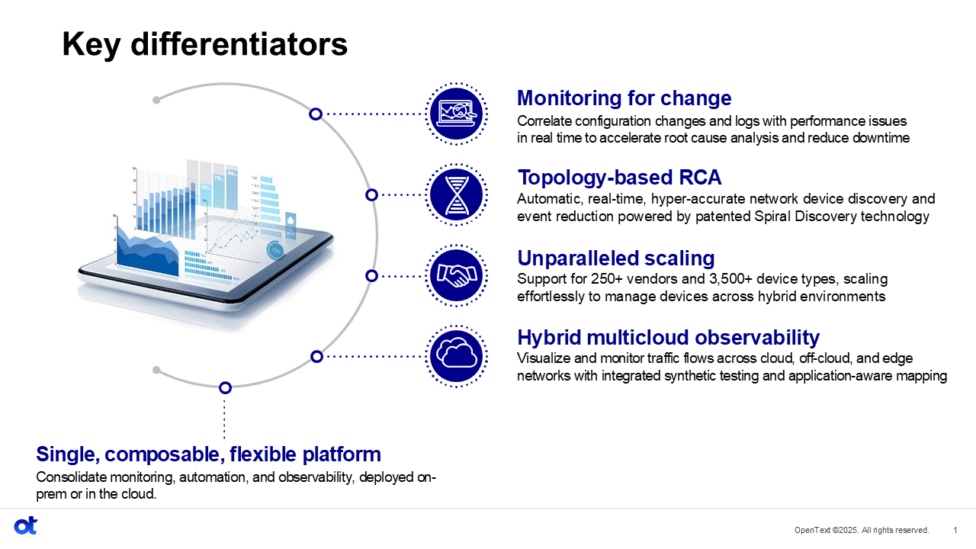
Innovation that sets us apart:
- NetDevOps integration: Git and Ansible integrations automate change control, improve visibility, and reduce risk through versioned, repeatable workflows.
- Deep firewall monitoring: Enhanced support for Palo Alto Networks and other vendors with visibility into firewall health, virtual systems, and security policies.
- Continuous Spiral Discovery: Patented, real-time topology mapping, and discovery that keeps your network model accurate without manual intervention.
- Hybrid multicloud network observability: Real-time insights into cloud connectivity, traffic flows, and performance to proactively detect, and resolve issues before they impact operations.
- Monitoring for change: Correlate configuration changes with performance and fault data to cut MTTR and quickly answer “what changed?”
- AI-powered diagnostics: OpenText Aviator brings intent-based diagnostics into network operations workflows, helping teams move from alert to root cause faster with contextual, AI-driven recommendations.
Looking ahead
As enterprise networks grow more complex in 2026, organizations need a network observability platform that can keep pace. OpenText Network Observability delivers the visibility, automation, and control needed to maintain network performance, strengthen security, and ensure compliance, all from a single platform with the deployment flexibility to fit your environment.
With proven results in reducing resolution times, support for 3,500+ device types, industry analyst recognition, and continuous innovation, OpenText is committed to helping enterprises achieve reliable, scalable enterprise network management. We continue to help customers succeed by leading the evolution from traditional network monitoring to full network observability.
Ready to see what OpenText Network Observability can do for your organization? Learn more about our network observability solution or contact our team to schedule a demo.