
Nine out of ten. Measurable ROI. That’s not a vendor claim, that’s what 127 technology leaders at companies with over $1 billion in revenue said when asked directly.
Get the full report – The state of AI adoption in ITSM and ESMSo, what’s the problem? Only 26 percent called those returns significant.
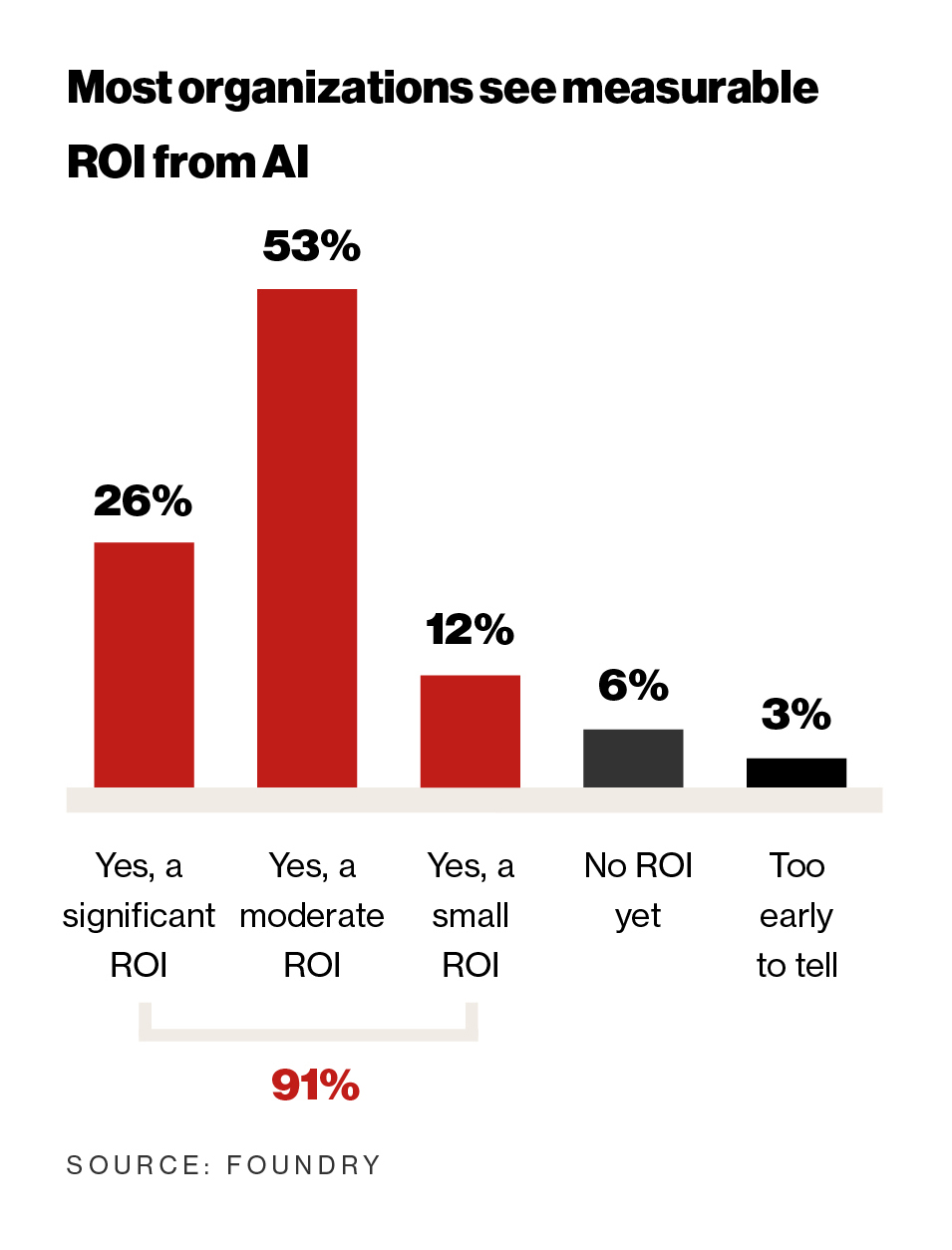
That gap—between “we see something” and “this is actually making a difference to our business”—is what this survey is really about. And if you’re an infrastructure and operations (I&O) executive trying to figure out why your AI investments feel incremental rather than structural, the answer is in the report.
Why are so many AI initiatives still stalling?
Let’s start with the baseline. The survey makes clear that AI in ITSM has crossed from early-adopter territory into the mainstream. Ninety percent of organizations are already engaging with AI through pilots or production deployments. Forty-three percent have moved past pilots entirely—AI is running in production.
And this isn’t just IT helping IT. Sixty-three percent of respondents report applying AI across both IT and non-IT functions, with departments ranging from HR to finance to facilities getting into the mix. The service management platform, once the domain of the IT help desk, has quietly become enterprise-wide infrastructure.
The most commonly reported benefits: productivity improvements, shorter resolution and response times, and reduced operational costs. These are real outcomes, not projected, but delivered.
What roadblocks are standing between you and significant ROI?
Despite broad adoption, 87 percent of respondents also reported barriers to moving faster. The top three won’t surprise any I&O leader who has tried to build something durable on an unstable data foundation:
- Low-quality data for AI training and usage
- Lack of expertise
- Unclear or unproven ROI
Read those together and a pattern emerges. Organizations are deploying AI before they’ve solved the underlying data and skills problems that determine whether AI actually performs. You’ve probably heard it before, the key to good AI is good data. The models go into production anyway. The quality isn’t there. The ROI disappoints. And then someone in a budget review asks whether this was worth the investment.
The fix isn’t slowing down adoption. It’s building the conditions for AI to succeed—and the survey is specific about what those conditions look like.
What separates “measurable” from “significant”?
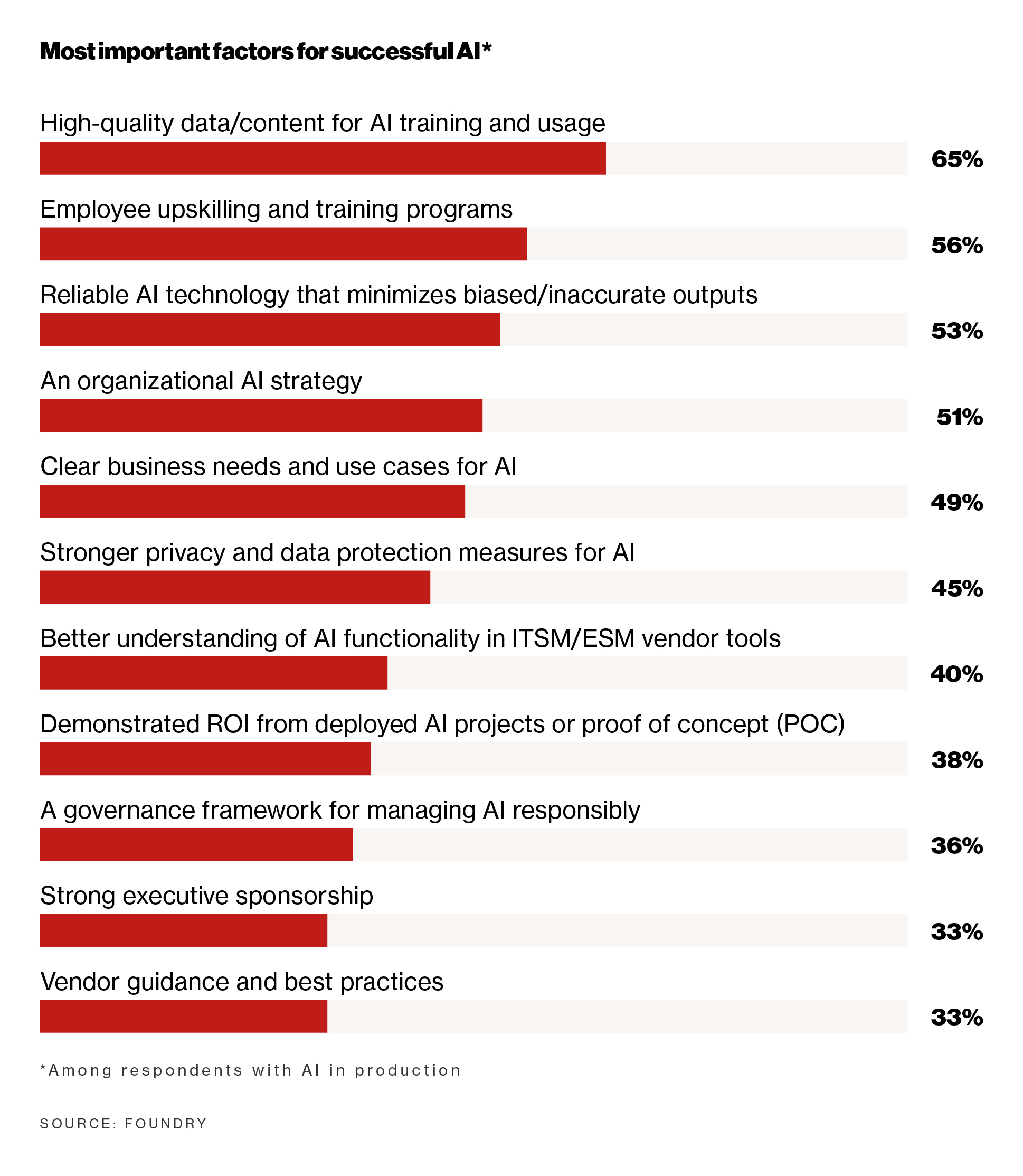
Organizations with AI already in production pointed to two factors above all others when asked what drives sustained success: high-quality data and content, and employee upskilling and training programs. It’s not new tools or bigger models. It is data quality and people.
That matters because it tells you where the real work is. Getting AI deployed is a milestone. Getting AI to actually perform—consistently, at scale—requires a different kind of investment.
The survey also shows that how broadly you apply service management strategy shapes your AI outcomes. Organizations with mature, enterprise-wide approaches, ESM, consistently report stronger results than those keeping AI contained to IT operations alone. There’s a ceiling built into a narrower strategy, and the data makes it visible.
Trust is growing. So are the stakes.
Seventy-five percent of respondents said they trust AI today, and 79 percent report that their trust has increased over the past year. Among organizations with AI already in production, trust levels are higher still.
That’s a lot of momentum moving in one direction. The question for I&O leaders isn’t whether AI is coming—it’s already here. The question is: do you have the data practices, the governance, and the workforce readiness to turn that investment into something that earns the word “significant?”
What will I get from the full report?
The survey data goes deeper than what’s covered here. If you want to understand exactly where your organization fits—and what the highest-performing teams are doing differently, I think the full report is worth your time.
Here’s what’s waiting for you:
- The agentic AI ambition gap: How organizations actually rank fully autonomous AI workflows vs human-supervised ones—and the number may surprise you.
- The maturity multiplier—quantified: The exact difference in significant ROI between organizations with ITSM-only strategies and those with ITSM and ESM strategies working together.
- Trust by deployment stage: How full trust in AI among organizations in production compares to those still in pilots—and what that gap tells you about your own roadmap.
- The large language model (LLM) compliance fault line: Why organizations using public LLMs report materially higher compliance and privacy concerns than those using private models—and what they’re doing about it.
- The most underrated use case in the survey: A capability that nearly every organization is either using or actively planning to adopt—one that quietly determines whether your AI investment succeeds or stalls.
Download the full report: Foundry, The state of AI adoption in ITSM and ESM, 2026.
Learn more: