
As we move toward the end of the year, IT leaders are already shaping priorities for the next one. For many organizations, enterprise service management (ESM) is near the top—whether the goal is to strengthen what’s already in place or expand ESM across the business. The real challenge is turning those ambitions into measurable outcomes that deliver business value.
According to the Gartner® How to Build a Successful Enterprise Service Management Program report, 45% of leaders cite maximizing their ITSM investment as the biggest benefit of ESM. Yet many organizations struggle to realize that value without a clear success framework.
Read the Forrester Wave™ for ESMWhat ESM really means
ESM takes the principles and practices of IT service management (ITSM) and extends them across functions like HR, facilities, legal, finance, payroll, and procurement. As we often say at OpenText: A service is a service—whether it sits inside IT or not.
With capabilities such as service catalogs, automated workflows, self-service, and knowledge management—now increasingly powered by AI—ESM delivers consistent, efficient, user-focused services across the enterprise.
Start with strategy, not the tool
Organizations that choose an ESM platform before defining objectives, governance, and success metrics often end up with a tool that doesn’t solve the right problems. Before selecting a platform or launching an initial workflow, align early with cross functional stakeholders to understand their needs, pain points, and constraints. Because ESM spans multiple departments, this alignment ensures you’re solving the right problems from the start.
Think beyond phase one. Successful implementations show value quickly in one area then move to other areas. This phased approach builds momentum and helps refine processes before scaling.
Make user experience a top priority. A fast path to failure is a system end users find difficult to use and avoid. Use clear, user friendly language, design for easy self service, and consider regional or departmental nuances that may impact terminology or compliance needs.
Build for learning and continuous improvement. Equip champions in each function to help onboard their teams, support change management, and gather feedback. Establish a consistent loop to refine services, improve workflows, and adjust to evolving needs.
How OpenText put ESM best practices into action
At OpenText, we aligned closely with these best practices for our own ESM program:
- CIO-level sponsorship ensured strong executive support.
- We partnered with HR—an early adopter with clear business needs.
- HR set clear goals: elevate the employee experience, reduce ticket volume by 20%, and expand self-service.
- We measured progress through CSAT, year-over-year ticket reduction, and self-service engagement. Notably, global CSAT improved from the low 80% range to 92%, driven by streamlined SLA tracking and simplified ticket management.
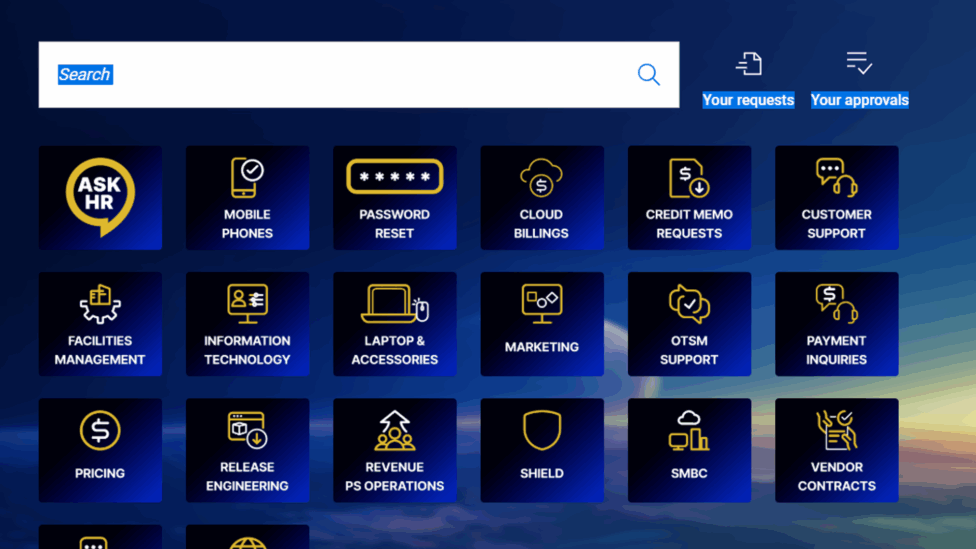
Today, 22,000 employees have one place to go for services. What started with HR a year ago has grown to more than 500 teams using OpenText Service Management, deploying processes and workflows that handle over 30,000 tickets each month. The results? Lower operational costs, simplified processes, and greater visibility into service performance.
Hear from Shannon Bell, EVP, Chief Digital Officer and CIO at OpenText, on how we set—and surpassed—our cost reduction goals. For example, in just one HR automation use case, we automated 20,000 high-volume, repetitive tickets, saving approximately 5,000 human hours—that’s 625 workdays reclaimed from repetitive tasks and redirected toward high-value work.

Your next step
Before scheduling a demo for ESM tool evaluation, ask yourself:
- Do we have stakeholder buy-in?
- Have we defined our business objectives?
- Do we know which functions we’ll partner with first?
Remember: ESM success starts with strategy. Technology follows.
For a deeper look how ESM vendors stack up and how OpenText™ Service Management provides a comprehensive foundation for enterprise-wide service excellence, read the The Forrester Wave™: Enterprise Service Management Platforms, Q4 2025
Explore more
- Scale service management for HR – Hear from our HR team on how they streamlined employee services through ESM.
- Modernize the employee experience – Hear from our Global HR VP Operations on driving efficiencies and empowering teams.
- What is ESM? – The role of enterprise service management (ESM) in modern operations.
- OpenText Service Management – Learn more about our solution and how it supports enterprise-wide service delivery.